



Primary Care
Want to learn more about this at Kettering Health?
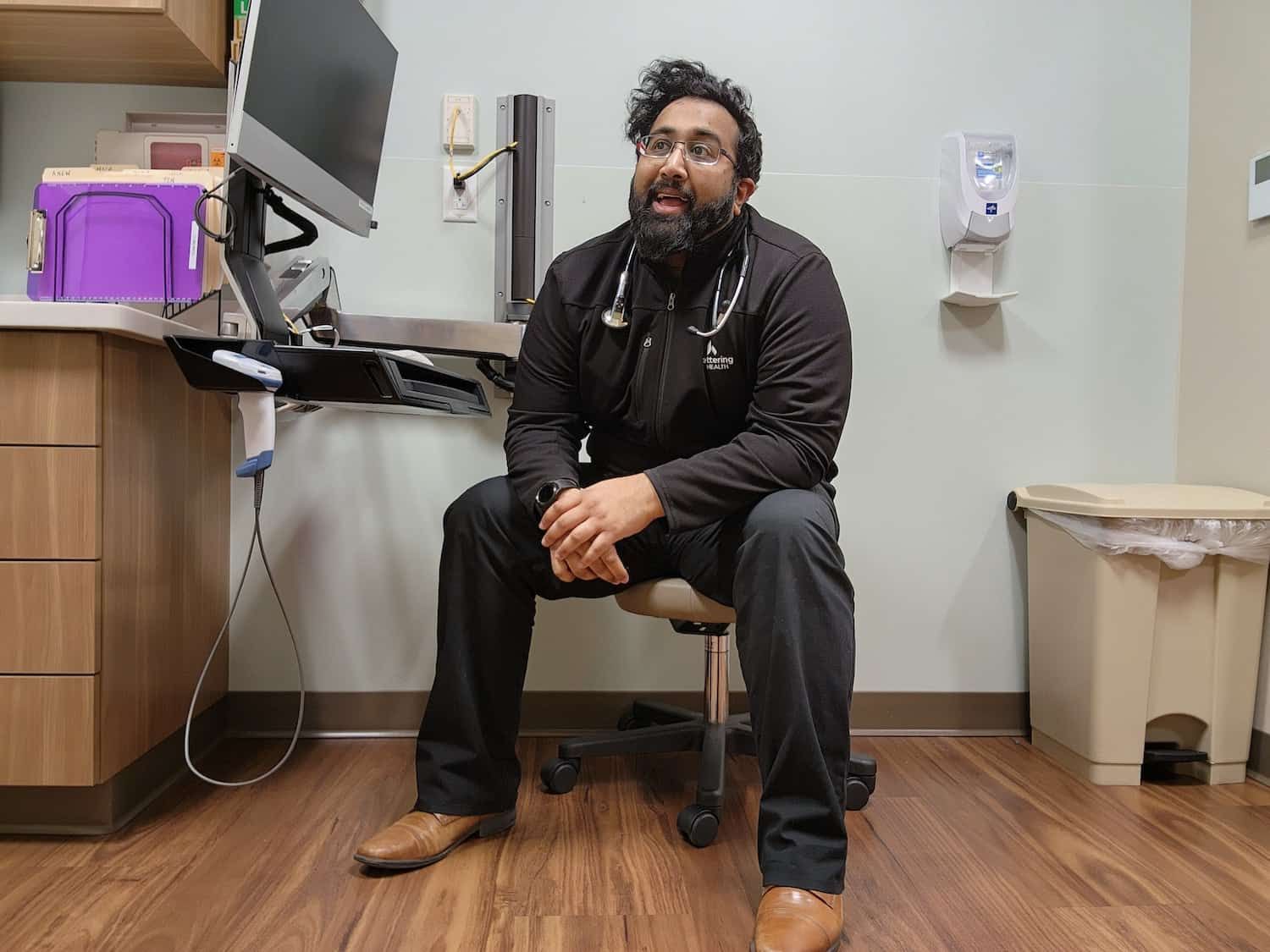
Debbie raises her hands above her head, as if to conduct an orchestra. In her left hand, she grips a crumpled tissue, soggy from tears. Her voice shakes and stutters as it grows louder, like a car struggling to accelerate, bouncing off the beige walls of exam room 17.
She recounts weeks of painful headaches that now disrupt the few things she can still enjoy, especially bowling. And she wonders about restless leg syndrome. And her new chemo regimen. But the elephant in the exam room today is her depression.
She drops her hands into her lap, casting her eyes down at her jittering white sneakers. She then looks up at a calm, focused Dr. Rukan Ahmed, her primary care physician. Or, as his patients call him, Dr. Salim.
Though her body relaxes a little, her eyes widen with desperation. Dr. Salim asks some questions, and she reaches to her right for a blue, flowery cinch bag with yellow straps. Pulling out small orange bottles, she squints at the labels and announces their names to Dr. Salim, who types at the computer hanging from the wall. Much of her life, it seems, has been contained in this bag since her breast cancer diagnosis five months ago. That’s when she met Dr. Salim.
Debbie drops a bottle in the bag as her voice cracks. Dr. Salim turns from the computer toward her as she dabs her eyes with the tissue.
“I just, I just don’t feel like I belong.” Debbie says. “Anywhere.”
“Actually, Debbie,” Dr. Salim says, “you do.”
Many roles, one goal
Primary care providers (PCPs) go by lots of names. But their efforts tend to focus on one goal: preventative care. “That’s why we call it outpatient care,” Dr. Salim says. “It keeps patients out of the hospital.”
And while preventative care helps patients avoid darkening a hospital’s doors, a PCP’s day-to-day efforts really converge to support patients as they traverse daily life outside a hospital’s walls and halls. This means PCPs are more than a walking rolodex of conditions, symptoms, and medications. They’re also detectives combing through evidence, looking for patterns of pathology that point to microscopic culprits. They’re coaches, creating game plans to improve patients’ health. They’re neighbors, learning about patients’ family, hobbies, even their pets’ names.
And they’re experts, of both the complexities of the human body and the invisible intricacies of the human condition. “I’m not just treating patients,” Dr. Salim says. “I’m often reminding them that they matter.”
Getting started
At 7 a.m., the streets start to thaw beneath cars rolling past Kettering Health Springfield as Dr. Salim arrives. Walking in, the heat pushes against mid-March’s chill as he turns toward the primary care offices.
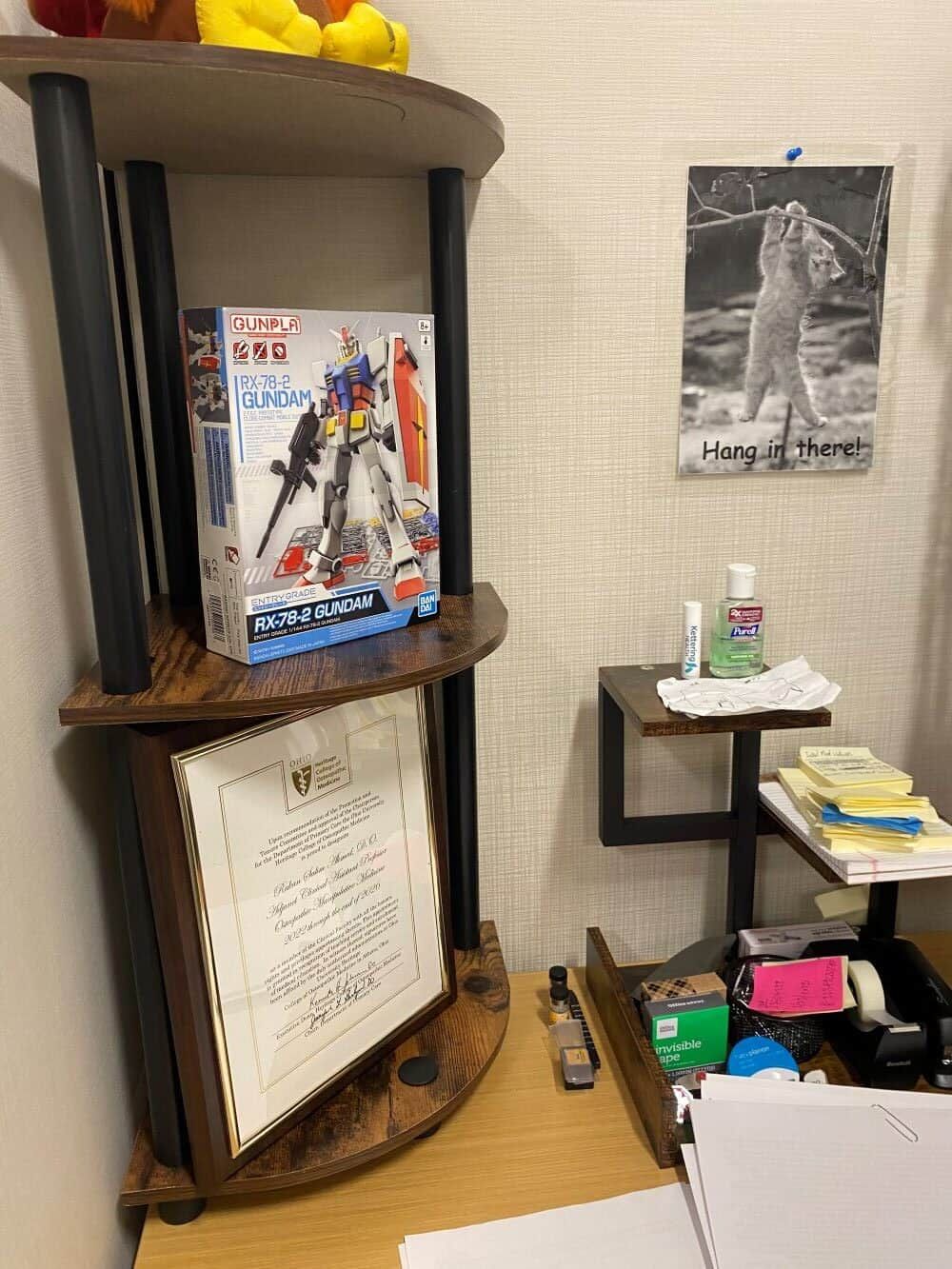
At his desk, he finds a list of the day’s scheduled patients on his keyboard. Near it are a Marvel birthday-party hat; an article entitled The Impact of Coffee on Health; an anime action-figure (Gundam Wing) building kit; and a framed certificate from the Heritage College of Osteopathic Medicine that reads, “Rukan Salim Ahmed, DO, Adjunct Clinical Professor.” His white doctor’s coat hangs on the back of his chair, where it stays all day. He actually prefers not to wear it around patients.
He sits to review notes from their previous visits, along with reminders of personal factoids he’s collected through conversation—video games they like, favorite foods, even anniversaries of sobriety. Looking at a note for Doug, his last patient today, Dr. Salim sees that today is Doug’s wife’s birthday.
He’ll see his first patient at 8 a.m. So Dr. Salim tackles administrative tasks—namely, updating electronic health records, or EHRs. For every hour a PCP spends with patients, roughly two to three hours of administrative work follows. During most weeks, that snowballs into about 60 hours.
Changing Stephen’s mind
Stephen, Dr. Salim’s first patient, worked years of long nights as a police officer. Along with difficulty sleeping and a taxed nervous system, Stephen brings into the exam room a family history that shaped his health and his view of medical professionals. He wrestles to trust them. But with Dr. Salim, after just two months, he speaks candidly.
“I’m 100 percent comfortable with him,” Stephen says.
And that’s no accident. Following Stephen’s first appointment, Dr. Salim received test results that revealed a condition Stephen was unaware of. Dr. Salim called him, staying on the line to answer rapid-fire questions and reassure him of the path forward. That call helped solidify Dr. Salim as a compassionate clinical expert. But it’s been his surprising vulnerability about his own similar struggles that humanized him for Stephen, effectively changing any view of Dr. Salim as a talking textbook to an empathetic expert. “There’s trust there,” Stephen says, “which changes what I’m willing to share, which makes or breaks my health.”
Dr. Salim defines this as PCPs being “stewards of preventable healthcare”—someone entrusted with others’ health. To earn that trust, Dr. Salim draws on his education and his story.
Learning on an improv stage
Growing up, Dr. Salim loved video games. In fact, he originally imagined becoming a video game designer. But just as present as any pixelated adventures were in his youth was also the professional adventure of patient care. His dad, an interventional cardiologist (and his professional namesake), introduced a young Dr. Salim to the habits of what he called a “patient-dedicated” physician. And those habits shaped who he became. He still loves playing video games, but caring for patients is where he feels he belongs. Or as Dr. Salim puts it, “It’s in my DNA.”
A young Dr. Salim also found a knack for comedy. As a “classic middle child,” Dr. Salim used humor to navigate feeling like an outsider. Humor also helped him develop self-awareness, which proved useful in learning how to relate to others. He’s since turned his knack for comedy into a craft as an amateur improv comedian. And in the way medical school taught him how to care for patients, comedy taught him how to connect with them—how to “listen” to body language, to intuit timing, and to use storytelling to create empathy.
And “Empathy isn’t something you learn from a textbook,” Dr. Salim says.
Crossing the digital divide
Dr. Salim returns to his desk around noon, following his 11 a.m. appointment with Debbie. Normally, he doesn’t eat lunch until later, keeping the lunch hour open for patients who can’t take the time off work. And cancelations occur, too, as they do for any physician. Today has brought a few, so he returns to EHRs as a Kenny G album plays on his computer.
At 2 p.m., Dr. Salim meets with Robert via a telehealth appointment. Like many PCPs, Dr. Salim has had to learn to cross the digital divide and the difficulties inherent with video calls, making them just as personable as in-person appointments. “He’s someone I could be friends with.” Robert says about Dr. Salim. “I trust him.”
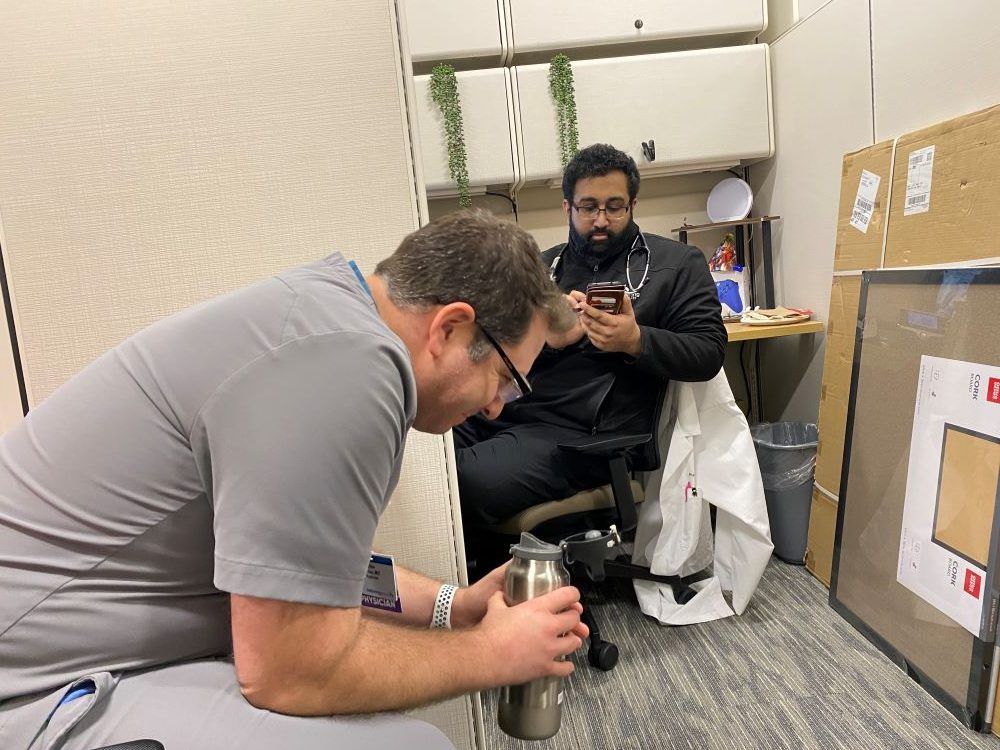
Dr. Salim signs off and talks with Dr. Knox, who’s in the cubicle to the left. Conversations are a mix of clinical talk and an ongoing battle of wits. They also happen to be each other’s PCPs.
“Tell me about yourself”
At 3 p.m., Dr. Salim meets with a new patient, needing now to cross the divide between two strangers. He arrives at the exam room and sits with Cari. He intentionally faces her, not the computer, and says, “Tell me about yourself.” Cari, in her mid-20s, has seen more physicians than most patients twice her age.
As she shares her medical history, her voice slides between frustration and reserved optimism: She’s eager for answers—even more eager to feel heard. Toward the end of the appointment, Dr. Salim recommends a test, using the paper covering the exam bed to draw and explain why. Cari’s shoulders soften as she agrees to the test. She knows answers may not lie around this corner. But, as she shared, “I feel heard for the first time in years.” She schedules her follow-up appointment at the front desk, caring little about the 40-minute drive to Springfield.
Dr. Salim has maybe three minutes to himself before walking back in to see Doug. It’s 4 p.m., and he knows Doug has squeezed this appointment into a busy day. Outside the exam room, Dr. Salim quickly opens an app on his phone, poking at pictures of flowers.
Not just a doctor
Doug is not the only member of his family who sees Dr. Salim. His wife, mom, and son are all patients of his. They discuss how Doug’s handled his shifting work schedule, which recently had him working 12 to 13 hours a day. Doug fidgets with a crumpled tissue, recounting his many commitments at work—practically all in the same nervous breath. As Doug pauses to exhale, Dr. Salim adjusts his seat.
Subtly pointing toward Doug, Dr. Salim says, “Just remember: When it comes to your health, you’re numero uno.” “I know,” Doug replies. “I trust you.”

Just before the appointment ends, Dr. Salim’s cell phone rings. Dr. Salim excuses himself for what Doug believes is a patient call, which doesn’t surprise him. He has Dr. Salim’s cell number, too. Doug’s eyes squint with confusion behind his glasses as Dr. Salim enters with a large brown paper bag. Handing the bag to Doug, flower petals poke out the top. Looking inside, Doug sees flowers, a candle, and some chocolate. A gift for Doug’s wife on her birthday.
Dr. Salim quickly recaps the takeaways from their appointment and tells Doug to have a great night celebrating his wife’s birthday. “He remembers things that have nothing to do with the appointment,” Doug says. “It makes it feel like I’m not talking to a doctor, but a friend.”
Going home
Back at his desk, Dr. Salim admits he feels the culmination of the past 10 hours as he completes notes after Doug’s appointment. Today, he won’t leave until closer to 9 p.m. after catching up on emails, charts and EHRs for the patients he’ll see tomorrow, and other administrative work. And even then, his day won’t end when the sliding doors at Kettering Health Springfield close behind him.
On the drive home, his mind wanders. Between thoughts about what to eat and how his cat is doing, he assesses the day. He wonders about the patients he saw today—could he have done better?—and about the patients he’ll see tomorrow—namely, how to make sure he’s the “steward of preventable healthcare” they need.
Because, as he puts it, “Everyone needs a good PCP.”



