Cancer Care
Want to learn more about this at Kettering Health?
Kids are often wiser and more aware than they’re given credit for. And they can be incredibly resilient. But nothing can prepare them for the emotions and shock of a parent’s cancer diagnosis.
Especially when that shock hits a family twice.
Just an ordinary family
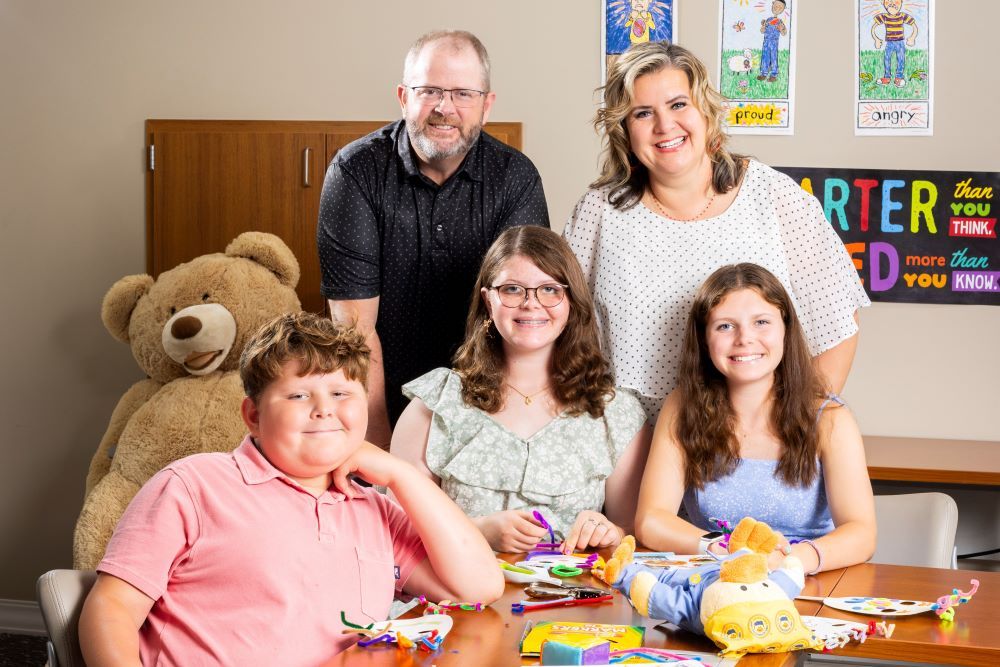
Two years ago, the Williamson family’s days were like those of many other suburban families. Chris, a pharmacist, and Melissa, a nurse practitioner, led busy lives, balancing work with raising their three active children. Afternoons and weekends were spent taking the kids to sports practices and band rehearsals; when one activity ended, they would host the team’s end-of-season pool party at their home as the kids started another sport.
A scary diagnosis . . .
On May 29, 2022, Melissa woke in the middle of the night with excruciating abdominal pain. Unknown to her, a mass had been growing in her upper right abdomen. She’d had no symptoms—until the mass hemorrhaged, filling her abdomen with blood. If that weren’t terrible enough, the mass, a pancreatic neuroendocrine tumor, was cancerous.
Melissa and Chris faced the difficult task of breaking the news to their children, Alivia (15), Eva (13), and Joseph (9). When the kids heard the diagnosis, they were tearful and scared of losing their mom. But they held onto hope. “We are a faith-based family,” Melissa says. “We believe that God will get us through.”
. . . followed by another
After Melissa’s surgery that July to remove the mass, the family thought they were on the other side of their frightening storm. But in January of 2023, Chris began having side pain and developed textbook signs of kidney stones. Testing determined he had multiple myeloma, a rare cancer of the plasma cells in his bone marrow. They learned that Chris’s cancer was treatable, but not curable.
When they told their children about Chris’s cancer, “They were all in shock, and all three of our children burst into tears,” Melissa says. “Joseph thought he was losing his dad and fell to his knees. Eva and Alivia said they didn’t understand how this happened.” The children now wondered: Would they lose both parents?
As a healthcare provider, Melissa was experienced in delivering difficult news to patients and their families. But nothing had prepared her for this. “I’ve told many people about the loss of their loved ones. I’ve told many people they have cancer,” says Melissa. “But to tell my kids, only seven months later, that their father had cancer in addition to their mother—it was probably the hardest thing I’ve had to do.”
A way forward
Melissa and Chris wanted their children to know they had support during this tumultuous time. “As a family, we developed a plan for them to talk to us if they were scared or had questions,” Melissa says. She also reached out to the children’s guidance counselors and teachers.
During one of Chris’s appointments with Dr. Kelly Miller, an oncologist, they were introduced to the CLIMB® program (Children’s Lives Include Moments of Bravery). CLIMB, developed by the Children’s Treehouse Foundation, is a national program that uses hands-on art activities and age-appropriate projects to help children develop skills to cope with the emotions related to the cancer diagnosis in their family.
At Chris’s first treatment, DeAnn Gallatin, LSW, an oncology social worker, gave the couple more information about CLIMB. “She was so kind and went over everything,” Melissa says. Kettering Health’s CLIMB program is for children ages five to 12. When Melissa told DeAnn that 13-year-old Eva was a worrier who tended to internalize things, they welcomed her into the program.
An oasis in the storm
Over the next six weeks, Eva and Joseph were eager for their CLIMB meetings. “They looked forward to it every Wednesday,” says Melissa. “They would say ‘When is CLIMB?’ and ‘We can’t be late!’”
The CLIMB program helps kids learn about cancer and treatment. Plush toys shaped like different kinds of cells give kids a visual of what’s going on inside their loved one’s body and help them understand chemotherapy and radiation. Other activities include using a stuffed animal to show kids where a port is placed and decorating cookies to learn about healthy cells and cancer cells. The kids toured where their dad would receive chemotherapy and spoke with medical professionals about what treatment looks like. And they heard everything in a way they could understand.
CLIMB also helps children learn how to process their complicated emotions. Activities like making a worry box gave the kids a way to discuss and then “store their worries” instead of carrying them around. “I could see the de-escalation, the de-stressing,” Melissa says, “the overall demeanor of my children changing.”
Invaluable lessons learned
Before CLIMB, Joseph didn’t want to leave his parents’ side. “He was in bed with us when I hemorrhaged,” Melissa explains. “He went to bed with us and [when he] woke up, his mom was gone.” After Chris’s diagnosis, it took them months to get Joseph to sleep in his own bed. He worried that he’d wake up and his dad wouldn’t be there. “The CLIMB program gave our kids the tools to process this situation and their emotions,” she says. “It gave them an outlet besides Mom and Dad to talk about it. They learned that there are [other] people there to help.”
Bubbles, boxes, and the three C’s
Eva says her favorite parts of the program were an outdoor bubble activity, learning how they could help their parents with cancer, and creating her worry box, because when they write down their worries “we can place our worries in the box, and we no longer have to worry about it because it’s in the box. That helped me a lot because I learned how to control my emotions, and they taught us how we can talk to people about our emotions.”
Joseph enjoyed “all the projects we did, and the food. I liked the masks we made and the worry box. I really liked seeing where Daddy got his treatments and seeing the radiation machine. The teachers were really kind, too.” But his biggest takeaway from CLIMB was learning the Three Cs”: “I didn’t cause cancer. I can’t catch cancer, but I can help people with cancer.”
While Melissa praises many things about CLIMB—the people and the process—she says the best part was that “my kids felt safe going there.”
After their children graduated from CLIMB, the Williamson family made a donation to Kettering Health’s CLIMB program so more children can benefit from it. “Even though my children aren’t the patient, they are a part of the patient,” Melissa says. “The CLIMB program fits into Kettering Health’s model of caring for the patient and the whole health of those involved.”
Looking to the future
As of July 2023, Melissa gets scans every six months and will need to do so for the next 10 years. But she’s been given a good bill of health and doesn’t require further treatment.
Chris recently underwent an auto stem cell transplant and is home, recovering.
When asked about their children’s progress, Melissa said that through faith, a supportive healthcare team, and the CLIMB program, “We are able to get through this. I can’t say how grateful I am.”