



Cancer Care
Want to learn more about this at Kettering Health?
According to the American Cancer Society, about 42,340 cases of liver cancer will be diagnosed in the United States in 2026.
While many patients with liver cancer are treated with surgery or radiation, there is one treatment that offers a non-invasive experience. Kettering Health now offers Histotripsy, a liver tumor treatment that utilizes ultrasound waves to target and liquify tumors without surgery or radiation.
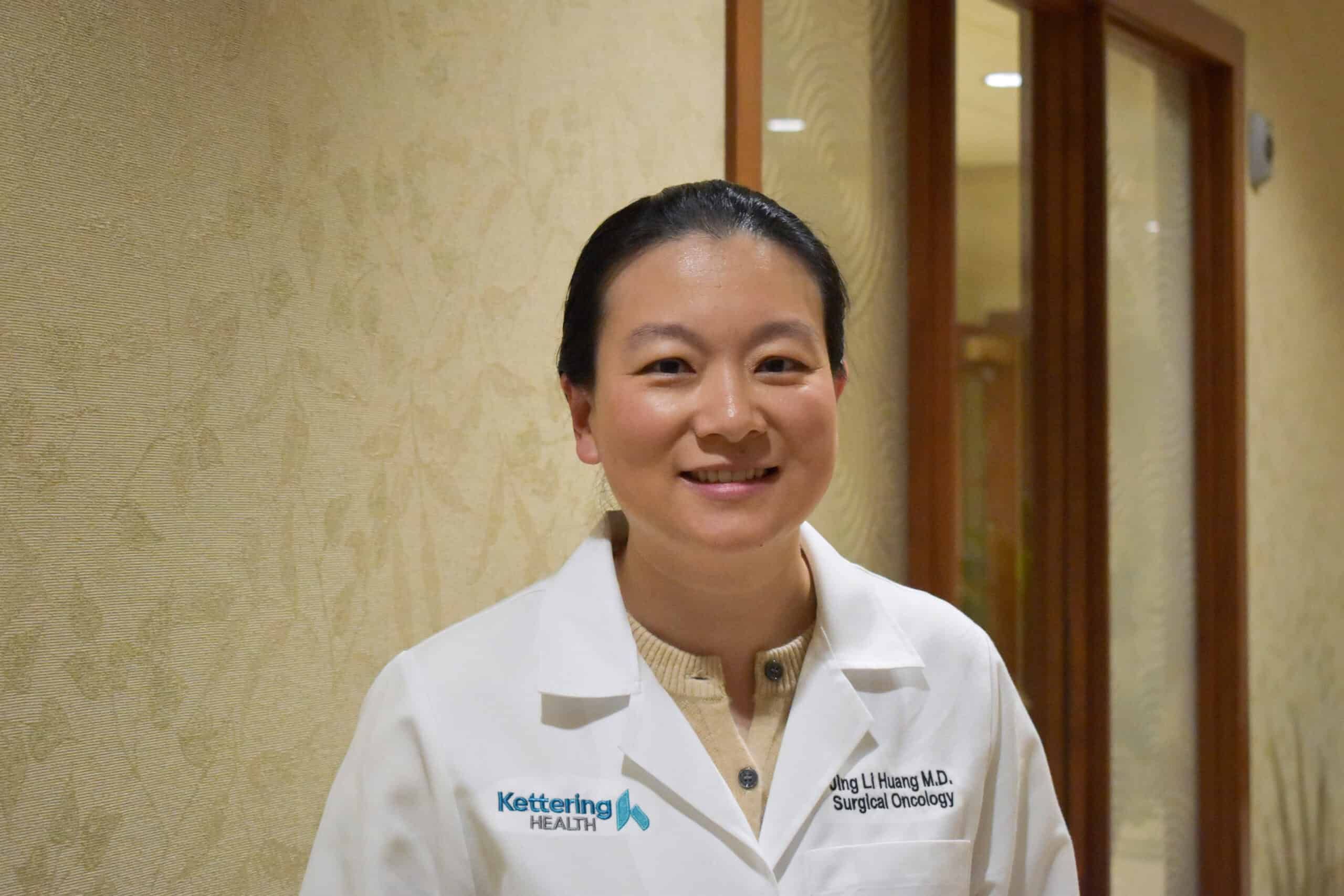
Dr. Anthony Paravati, executive medical director of the oncology service line, and Dr. Jing Li Huang, a surgical oncologist, are two of three physicians in the organization who have completed training for this new procedure.
What is Histotripsy?
Histotripsy is a non-invasive procedure that directly targets liver tumors using high-energy ultrasound waves.
“There’s no punctures, unlike surgeries, ablations, or other types of treatments for liver tumors,” says Dr. Huang. “It essentially liquefies the tumor without injuring the specific important structures that it may be close to.”
What can patients expect?
Before the treatment, patients are placed under general anesthesia to stabilize the liver.
“The liver moves with breathing, and to give the treatment accurately, you have to be able to control the motion of the liver,” says Dr. Paravati.
Ultrasound is then used to create parameters around the liver for treatment, which typically takes about 10 minutes. After this is complete, ultrasound waves are used to liquify the tumor.
“The machine systematically marches through the intended volume of the liver, because it’s only treating a point in space,” says Dr. Paravati. “Think of it as a little bit bigger than a pen point. That pen point will migrate through the entire target volume, which is three dimensions.”
Once the treatment is finished, the machine is removed from the surface of the patient, and they are recovered out of anesthesia. Throughout recovery, patients see very minimal side effects, with some experiencing skin changes around the treated area, which can be remedied with ointment.
“The recovery process is minimal after the Histotripsy,” says Dr. Huang. “Sometimes the patient might need to stay overnight in the hospital for monitoring, but other times, if they’re doing well, then they get to go home the same day.”
Following the procedure, patients are regularly monitored to ensure that the treatment was successful.
“We follow up from the procedure with either a CT scan or an MRI to see the area that we’ve treated,” says Dr. Huang. “Within 30 days, we get another scan to monitor that area, and then we continue monitoring the process every three to six months to ensure that the area has been adequately treated and that there’s nothing that comes back in that area.”
Why choose Histotripsy?
While all liver treatments have their pros and cons, Histotripsy stands out with its non-invasive aspect.
“Some people may not be able to undergo a surgery well, so a non-invasive type of treatment would be better for them,” says Dr. Huang.
Another advantage of this technology is its ability to address tumors located near major blood vessels or bile ducts without injuring those structures.
“If a particular tumor was next to one of those major blood vessels or bile ducts in the liver, the other types of treatments might not be able to treat that tumor adequately, whereas Histotripsy can,” Dr. Huang says.
The size of the tumor is also considered, as Histotripsy treats smaller tumors more effectively.
“It is a type of treatment that is able to treat tumors that we would not otherwise be able to treat,” says Dr. Huang.
Impact on the community
With the introduction of Histotripsy, the potential for treating other cancers non-invasively continues to grow.
“With Kettering Health investing in this technology, we’re building a new capability and bringing a new modality that in the near future will have even broader application beyond the liver, likely kidney, potentially pancreas cancer, as near-term future additions,” says Dr. Paravati.
With its unique capabilities and continued development, Histotripsy is a beneficial addition to the community.
“At Kettering Health, we have a very strong innovation culture and a drive to evaluate new opportunities very carefully,” Dr. Paravati says. “And once our evaluation demonstrates that it will be a benefit to patients, we don’t hesitate to bring that, to develop those programs, and make those things available.”
Wondering if histotripsy may be right for you? Patients can self-refer or be referred by a physician. Call 1-855-500-CURE (2873) to speak with our team and learn if you may be a candidate.
Learn more about Histotripsy
Learn More



