Cancer Care
Want to learn more about this at Kettering Health?
In the winter of 2024, Montgomery County Sergeant James Gisewite stretched his arm out in front of him and felt a sharp pain in the back of his shoulder. When he reached back to investigate, he discovered a lump just beneath the skin.
Four years earlier, in 2020, James had undergone a biopsy to remove a suspicious mole after persistent encouragement from his wife, Cassie, to have it examined. The mole was determined to be a stage II melanoma and taught him the importance of getting unusual changes checked out promptly.
When he discovered the lump on his shoulder, James already had an annual wellness visit scheduled a few days later, so he mentioned it to his primary care provider.
“He felt it was just a fatty deposit that needed to be removed,” James recalled. “He didn’t think it was a big deal at the time.”
Over the next several weeks, however, the lump continued to grow and became increasingly tender. Concerned, James decided to discuss it with his dermatologist. As luck would have it, his routine three-month dermatology appointment was only a few days away.
Believing the lump was likely a benign lipoma, his dermatologist referred him to a plastic surgeon for removal. However, in the weeks leading up to that appointment, the lump continued to grow, and the pain intensified, developing into a shooting pain that traveled through his shoulder and down his arm.
“I knew something wasn’t right.”
James returned to his primary care provider where an ultrasound was ordered. The ultrasound was ordered on a Friday, and the results came back later that evening.
It was more than a fatty deposit or a lipoma.
It was a tumor.
Life-changing results on a Hawaiian vacation
Dr. Rebecca Tuttle, surgical oncologist at Kettering Health, had removed James’ melanoma in 2020, so he knew he could rely on her specialized expertise to determine if the newly discovered tumor was cancerous or benign. He put a call into her office the Monday after his ultrasound results came in.
His appointment was scheduled for the next day, which also happened to be the day before he and his family were scheduled to leave for a Hawaiian vacation.
To avoid a more invasive biopsy procedure that would have limited his ability to enjoy the vacation, Dr. Tuttle performed a fine-needle aspiration, collecting tissue samples for testing.
While James and Cassie were docked at one of the Hawaiian Islands, he received a MyChart notification.
“I told Dr. Tuttle’s office I wouldn’t look at the results until after vacation, but when I saw we had reception, I couldn’t help myself.”
The results showed that the tumor was cancerous.
Stage IV melanoma.
As soon as they reached an area with stronger cell service, James called Dr. Tuttle’s office to discuss the next steps.
Additional testing was scheduled immediately, including a brain MRI and a PET scan to determine whether the cancer had spread.
The brain MRI showed no evidence of cancer in his brain. However, the PET scan revealed that the disease had spread to his shoulder, a lymph node under his arm, his sternum, and his left lung.
For James and Cassie, parents of two, the prognosis seemed bleak.
“My wife and I were pretty much under the assumption that once Stage IV melanoma spreads, you’re finished. Done.”
From hopelessness to hope
To begin treatment, James was referred to Kettering Health Medical Oncologist Dr. Kelly Miller.
As Dr. Miller answered their questions about treatment options, she said something that James and Cassie never expected to hear: She believed an aggressive treatment plan could eradicate the cancer.
“I said, ‘Wait a minute. Time out. Did you say you could basically get rid of this?'”
Dr. Miller’s response was simple: “Yeah, we can get rid of it.”
“My wife and I were in total shock. We did not see that one coming. It was a blessing to hear that.”
Those words gave James a renewed sense of hope. Leaning on his faith, his family, and his care team, he prepared himself for an aggressive and physically demanding treatment journey.
Dr. Miller recommended they get started immediately.
“My appointment was on a Tuesday,” recalls James. “She looked at me and said, ‘Are you ready? I want you to start treatment by Friday. I said, ‘Yeah, let’s get this going.'”
A setback in treatment
Due to the extent to which the cancer had already spread, James’ treatment plan included multiple rounds of intensive immunotherapy treatments. His care team warned him that significant side effects were possible.
“The first round put me in the hospital for a week,” said James. “It caused severe inflammation in my lungs.”
Despite the challenges, James remained determined to keep fighting.
His care team quickly responded with steroids that reduced the inflammation and allowed him to continue treatment.
“When I was in the hospital with the lung inflammation, struggling to breathe, I didn’t even realize that the pain in my shoulder had stopped and that the lump had already started to shrink.”
The treatment was working.
Life goes on during treatment
After his hospitalization, James was able to continue working at the sheriff’s office throughout his following rounds of treatment. Fortunately, his responsibilities as a sergeant were less physically demanding than patrol work.
Remaining at work helped provide a sense of normalcy during an otherwise difficult period.
“I get stir-crazy. I can’t stand sitting at home every day, so being able to go to work really helped because it kept me occupied.”
Looking ahead
In May 2026, James received his first clear PET scan showing no evidence of cancer.
While his journey is not yet over, the milestone marked an important victory as he makes his way toward his final round of treatment in January 2027.
Through it all, James has come away with a simple but important message: Stay current with routine screenings and annual checkups, and don’t ignore changes in your body.
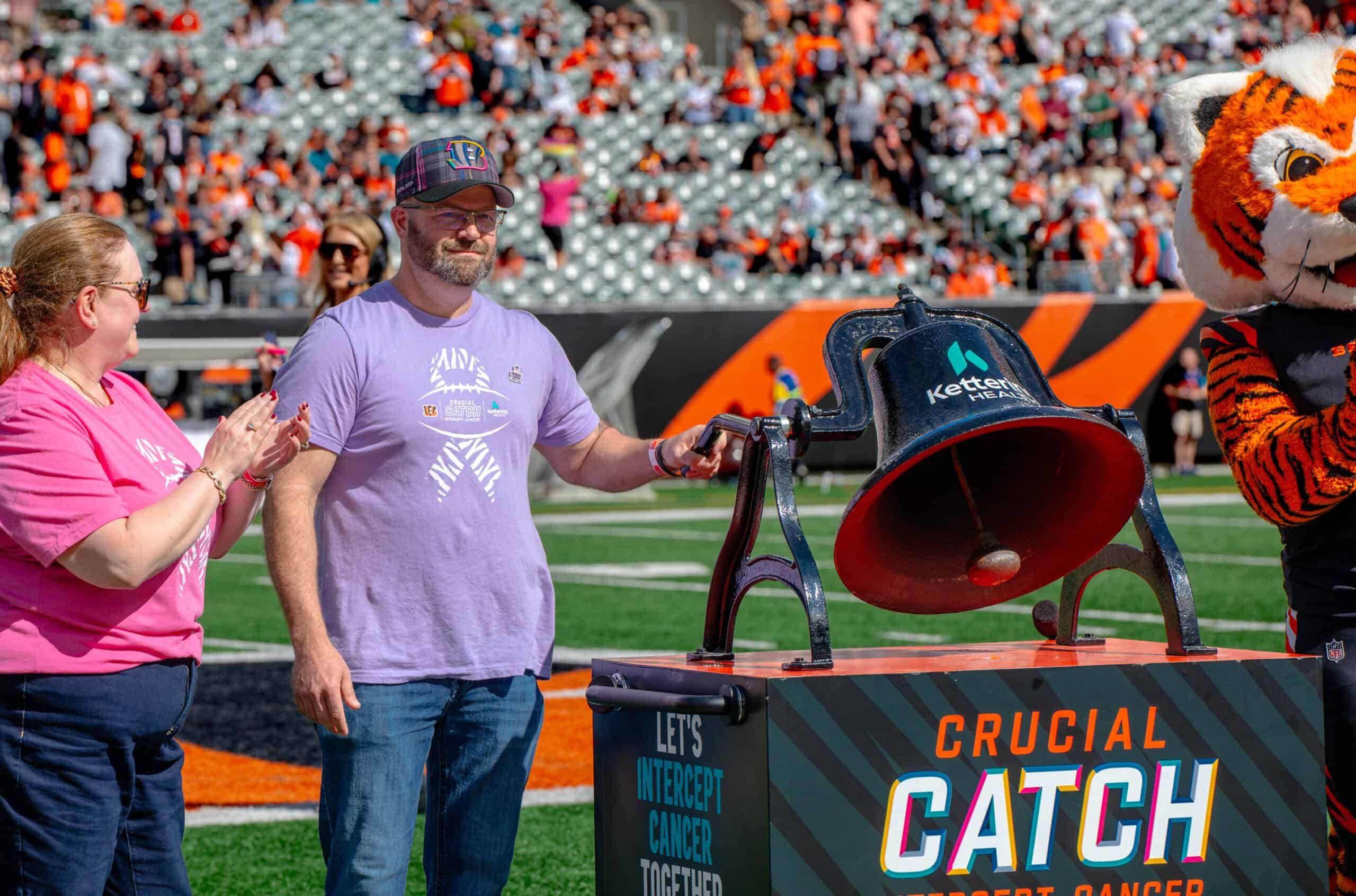
This lesson aligns closely with the goal of the NFL’s Crucial Catch initiative – to intercept cancer at its earliest stage through routine screenings. On October 4, 2026, James participated in the Crucial Catch game, where he had the opportunity to ring the bell alongside others whose lives had been impacted by cancer.
“I had not been able to ring a bell yet, so getting to do that during the halftime ceremony at the Crucial Catch game was really special.”
James will have to undergo imaging every few months for the foreseeable future to monitor any signs of recurrence, but he says another important thing this journey has taught him is the importance of staying positive.
“Just stay positive and make sure you’re keeping up with your regular checkups.”