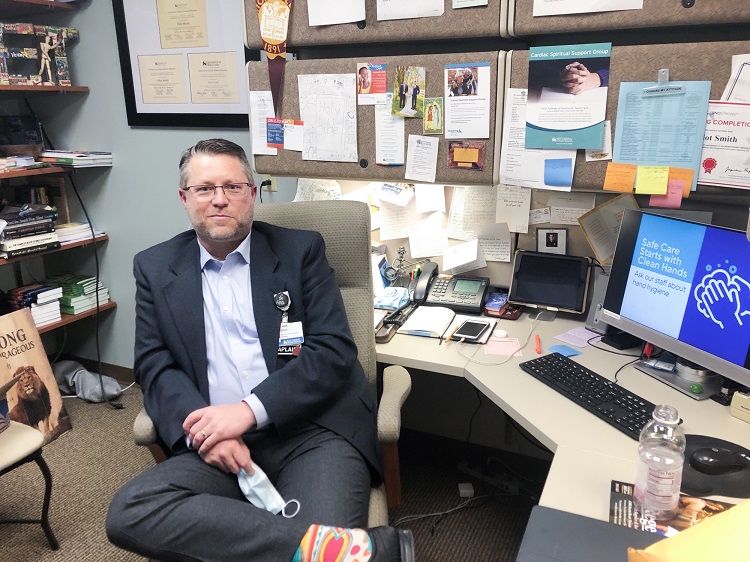
Elliot Smith knows that tears, like words, tell stories. And he has learned how to listen to both.
Sitting with a nurse after her shift at Kettering Health Main Campus, Elliot listens as she struggles to speak through her mask and her anguish.
A newer nurse, she began her career with her mind and hands ready to care for patients. But by the winter of 2021, the COVID-19 pandemic had overwhelmed her soul.
She, like many medical staff, feels weariness setting into her bones. She’s given everything for months, pushing against the microscopic enemy with one hand and trying to care for patients and their families with the other. Today, she feels the pandemic pushing back. And she’s losing her footing.
She gives a shaky voice to her fears, questions, and even doubts—the “What Ifs?” and “Whys?” that come from a place too deep for masks, gloves, and goggles.
And with the tender assurance of a friend, Elliot listens.
He knows she wants answers. But he sees in her eyes that what she needs in this moment is to feel safe, to feel seen, and to feel connected with someone who isn’t pixelated behind a screen.
And when the time is right, he gently reminds her of two things: she’s human, and she’s not alone.
A passion of biblical proportions
Elliot Smith, lead chaplain at Kettering Health Main Campus, began these “debriefing sessions” in the thick of the pandemic. He and other chaplains throughout Kettering Health wanted to give clinical staff caring for patients with COVID a space free of news feeds, political spin, and an escalating sense of futility to come and be themselves.
“These folks are incredibly intelligent and do things I could never imagine. And they were watching patients they’d grown to care for placed on ventilators. And they wanted to do more. They felt powerless,” said Elliot. “We simply started to say, ‘Hey, if you want a chance to talk after your shift, we’ll be here.’ And that’s what we did. We sat with them, and we listened.”
These debriefing sessions became one of the ways Elliot and the other chaplains have embodied an indispensable role throughout the pandemic. It’s a role Kettering Health has valued for years as a faith-based health network. And it’s one the pandemic has, in no uncertain terms, shown can meet perhaps the deepest of needs in times like these.
And it’s a role Elliot has a passion of biblical proportions for.
Learning to “minister in the moment”
“I wanted to help people navigate life. And I knew it needed to be from an emotional and spiritual approach,” said Elliot.
Elliot began his career as a trained psychiatric social worker. But he knew people were multifaceted, more than skin, bone, and tear ducts. He wanted to care for them on every level—mind, body, and spirit. So, in addition to his psychiatric training, he pursued training as a pastor and received his master’s in social work.
“I wanted to provide spiritual and emotional help in a therapeutic way.”
He moved to Dayton with his wife in 2006 and became a chaplain at a local private school. He then joined Kettering Adventist Church for nine years, serving as a pastor to young adults.
During that time, in 2016, after serving as an evening on-call chaplain for local hospitals, the director of spiritual services at Kettering Health Main Campus called him. And Elliot joined as a staff chaplain.
His first two years, Elliot cared for patients and their families, practicing what he calls “ministry in the moment.” A key facet of chaplaincy training at Kettering Health, this approach to ministry helps chaplains-in-training realize they may have only a few minutes to connect with and meet a patient’s or family member’s emotional and spiritual needs.
“I might see a patient once, for 30 minutes. ‘Ministry of the moment’ is not about forcing results or a turning-around point in a patient’s life. Rather, it’s a paradigm shift to help patients understand how to think about their questions, their emotions, and themselves.”
A bigger mission of healing and hope
This approach to chaplaincy departs from what others may think when they hear “chaplain.” As a chaplain, Elliot avoids being an answer machine, wandering the halls, offering philosophical platitudes and Bible references like fortune cookies. Instead, he sees himself—and wants others to see him—as a human connecting with another human, in all their God-given complexity, approaching together the wonderful mystery of God’s love.
“I’m afraid some people believe chaplains have some sort of ‘spiritual authority’ that the ordinary person can’t,” said Elliot. “I believe I’m ordinary. And my prayers are the same as anyone else’s. I’m honored when patients ask me to pray. It’s a spiritual moment to pray together. But I don’t believe my prayers are more gifted or supernatural than a patient’s, nurse’s, physician’s, or an EVS worker’s.
We’re all part of God’s bigger mission of healing and hope.”
Part of that mission for Elliot, early on, included finding ways to relate to and care for the staff. The now famous-among-employees care carts, goodie-filled carts that chaplains wheel through the halls, began with Elliot and his relationally driven vision.
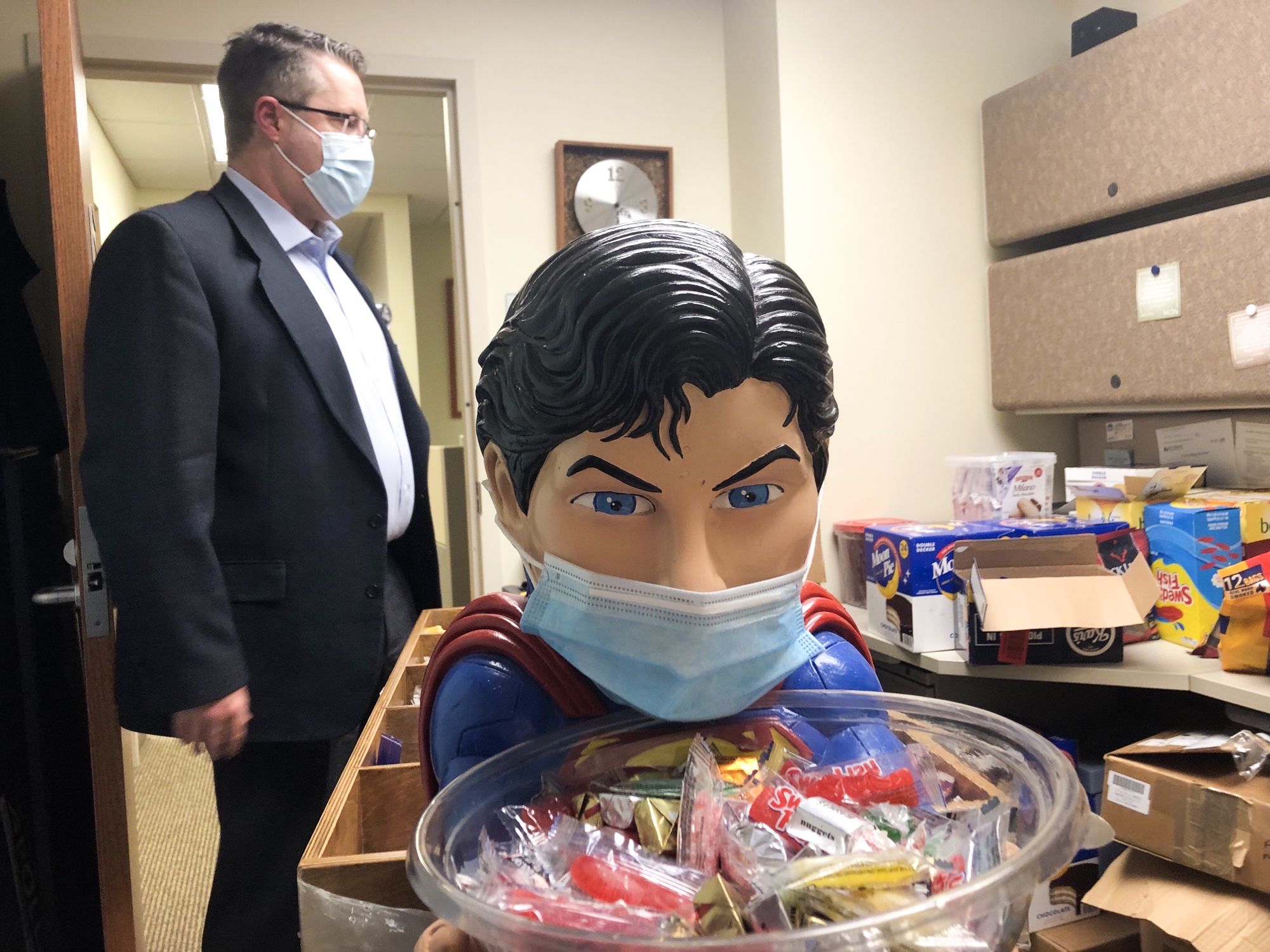
Being a comic book fan, Elliot has outfitted one of the carts with a Superman figure.
“It’s a tool for relationship building,” he said. “I put things in the care cart that remind staff of their childhoods. The conversations turn from what life is like for them now to what life was like for them as kids. It’s a conversation starter.’
But I didn’t know what it would mean later for the staff.”
Hearing only the hum of TVs
Walking up the stairs from his office, Elliot approaches a desolate lobby at Kettering Health Main Campus. The sliding glass doors stand motionless. The darkened gift shop holds no shoppers looking for “Get Better” balloons. And the main desk sits void of smiling neighbors wearing “volunteer” badges.
Elliot walks toward the stairs, engulfed in silence. The buzz of his pager interrupts the click of his shoes against the floor. He’s needed for an end-of-life conversation for a patient with COVID.
It’s November 2020, and it’s the third one today. And it won’t be his last.
As he walks toward the COVID unit, he hears only one thing: the hum of TVs from patients’ rooms.
“All you could hear were the TVs,” said Elliot. “No families laughing or crying.”
As the first wave of COVID approached the Miami Valley in early 2020, Kettering Health, like every healthcare organization across the U.S., limited on-site staff to only clinical staff and enforced a necessary no-visitor policy. Elliot and the other chaplains went home to stay isolated, along with the rest of the world.
In other hospitals in parts of the country crippled by COVID, the effects of isolation on patients and staff had already become clear. It didn’t take long for the leadership of Kettering Health’s spiritual services to suggest that chaplains be considered “clinical” so they can support the patients and, especially, the frontline workers caring for them.
The next week, Elliot returned to his office. Despite COVID’s looming presence, Elliot knew he needed to walk the same halls the staff walked as they cared for patients with COVID. And he knew it’s where God wanted him.
“It was scary. No one knew much about COVID. But I was inspired by the staff,” said Elliot. “I felt confident I was where God wanted me to be.”
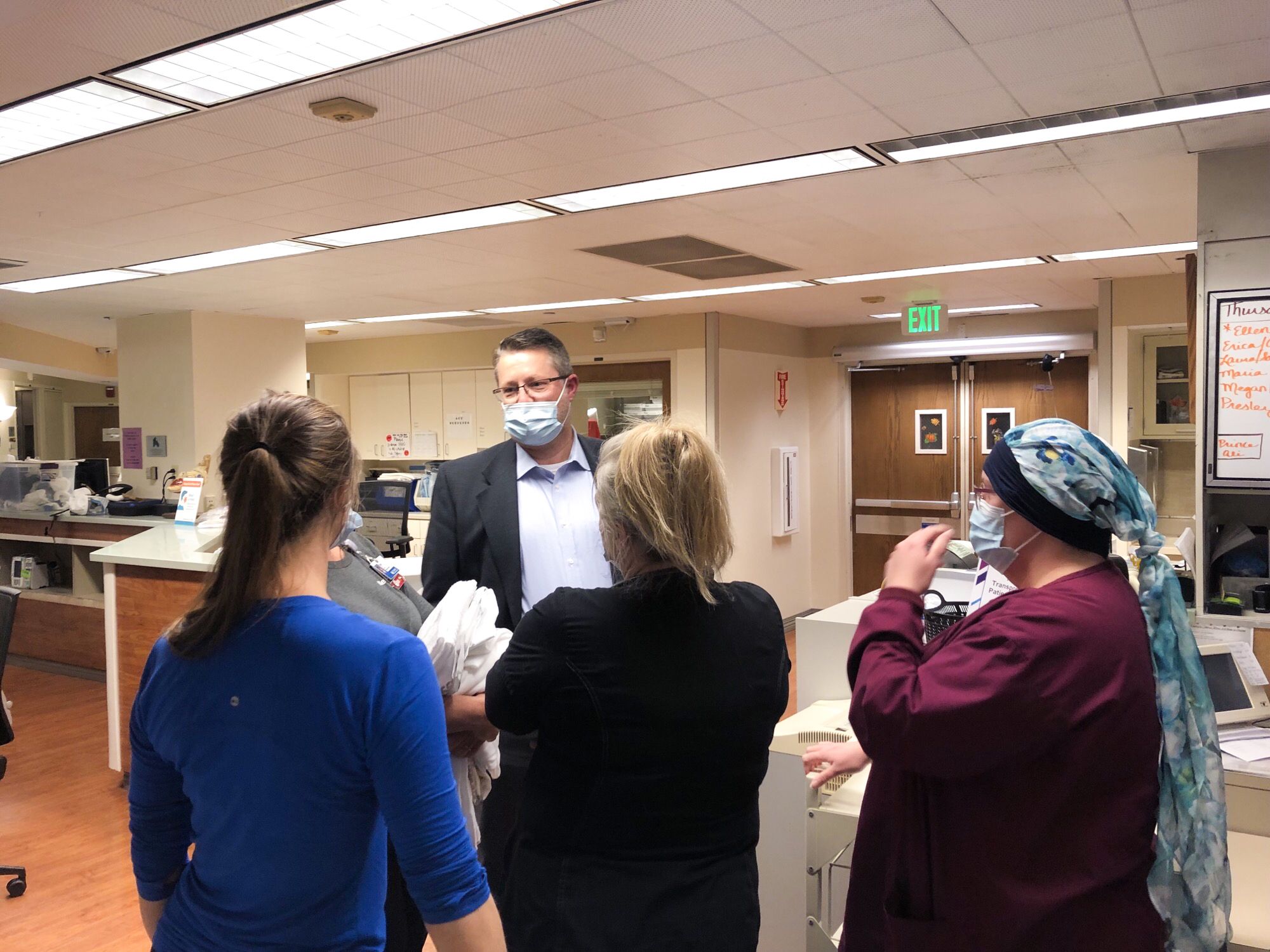
As weeks turned to months, Elliot did everything he could—at all hours he could—to support emotionally and spiritually the ever-pressured staff—those whom Elliot referred to as “wounded healers.”
Whether he was bringing the care cart through the hallways, creating respite rooms where staff could relax for a moment, hosting debriefing sessions for the weary, or stepping into a COVID unit to ask, “How are you doing?”, Elliot and the other chaplains became a steadfast presence—a fixture of faithfulness—in the lives of those caring for patients with COVID.
As they pushed against the onslaught of COVID and the enormity of grief it brought, Elliot stood behind them, supporting them in the flesh with emotional and spiritual support, helping them not lose their footing and faith. Or, if they did, someone was there to catch them.
At the intersection of patient care and human limits
Elliot and the other chaplains became a beacon of warmth, compassion, and grace throughout the first year of the pandemic. So much so that when the next wave of COVID approached Kettering Health’s medical centers in 2021, the chaplains and spiritual services team were ready to respond to the call.
“That first wave, we as chaplains raised our hands and said, ‘Hey, I want to help.’ That following wave, it was not us raising our hands, it was leadership saying, ‘Chaplains go do your thing.’”
Since then, Elliot and his team have continued to care for staff, building deeper bonds of trust. “That was the blessing of the pandemic, so to speak: it allowed chaplains like me to develop relationships and trust with staff so I can better serve on the same team as them.”
Throughout the pandemic, chaplains like Elliot witnessed the realities physicians, nurses, therapists, and others faced at the intersection of maintaining a deep commitment to patient care and encountering their own human limits. And it’s at that intersection Elliot has planted his feet throughout the pandemic.
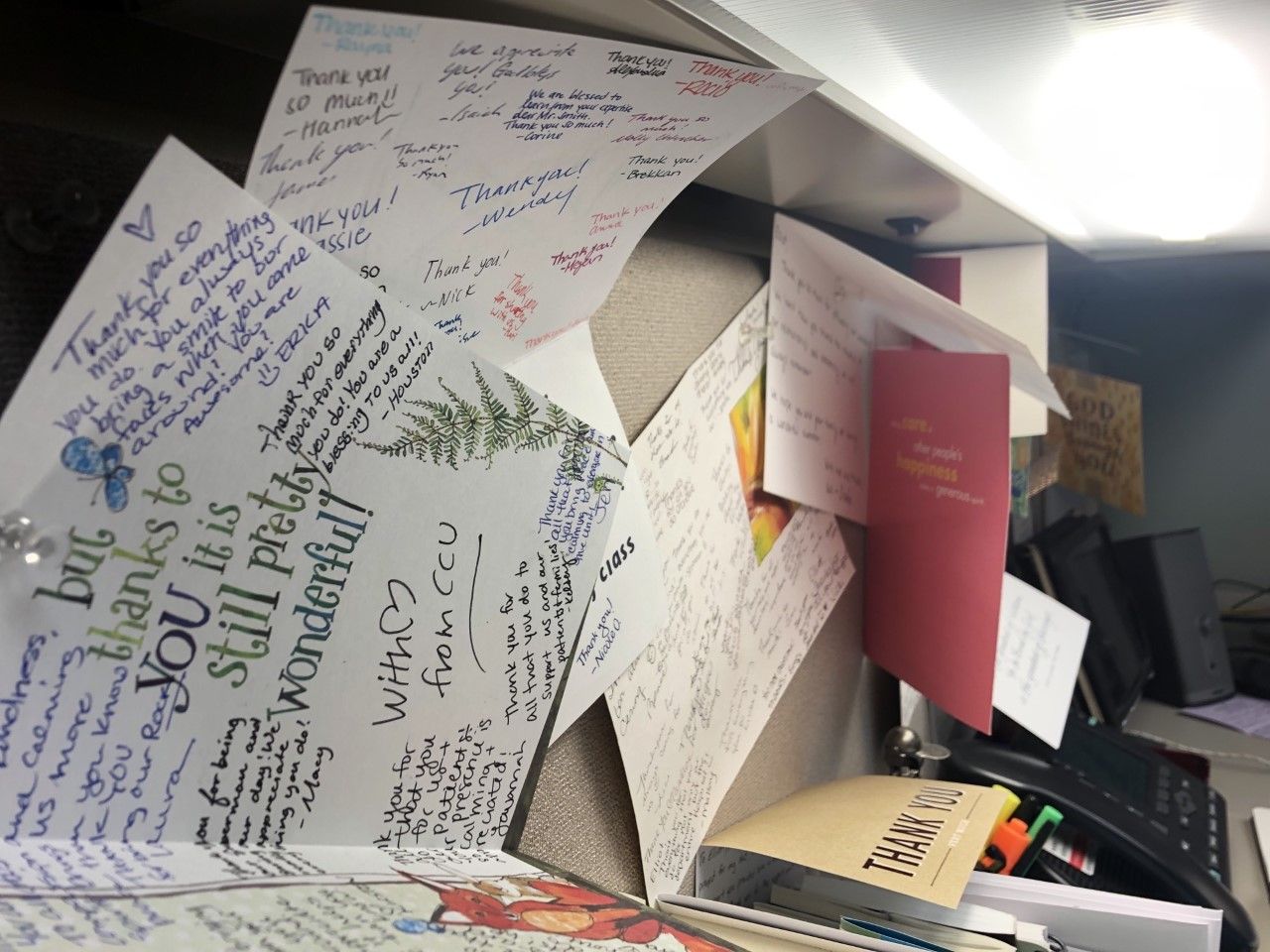
As Dr. Hemant Shah, medical director of the ICU at Kettering Health Main Campus, shared, “One person’s presence remained throughout the pandemic: Elliot’s. Throughout everything, he has always been our side, whether it was alongside physicians, nurses, therapists, or families—and that presence made a huge difference.”
Although Elliot doesn’t want to be seen as an “answer machine,” he does know one thing for certain. The pandemic robbed families of normalcy, revealed everyone’s emotional fault lines, and rattled the world’s cage.
But it has not had the last say.
Today, because of the pandemic, Elliot and the staff know more deeply the central role chaplains play in patient care and staff support.
“It has enabled staff to see chaplains as a necessity that goes beyond just a religious measure,” said Elliot. “I had already known that. But this crystalized it. And it became clear in a way that wouldn’t have been without the pandemic.”
In other words, even though this chapter of the pandemic has caused countless tears, Elliot knows God is using it to write a bigger story.
And for a chaplain who wrestled with his own questions about faith, God, and the pandemic, knowing a larger, history-wide story of healing envelops this dark chapter, and every dark chapter, offers him more hope than any single answer to “Why?”
And it’s that sturdy story of hope he brings to patients and staff, a hope that both supports the weary, calms the fearful, sustains the brokenhearted, and heals the deepest of wounds.
Caring for the wounded healers
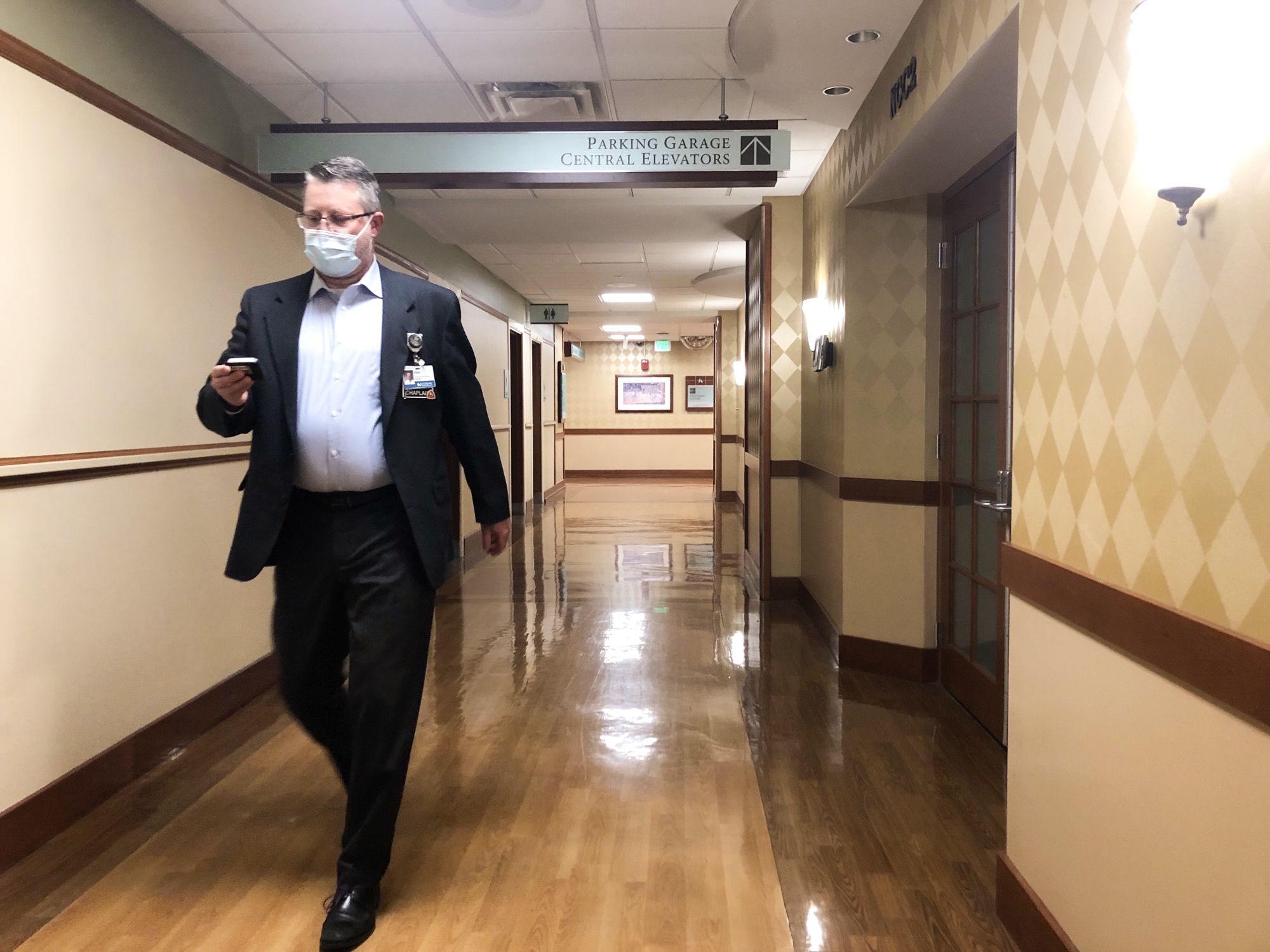
Walking down a hall at Kettering Health Main Campus, Elliot checks his buzzing pager. He’s needed in a patient’s room.
On his way, passing through a lobby busy with volunteers at the front desk and shoppers in the gift shop, nurses and doctors alike wave and say hello. At the elevator, someone takes a moment to ask Elliot a question.
To any onlooker, they may think Elliot is a local celebrity or even hero. But for Elliot, he’s neither. He’s a human helping others navigate the emotional and spiritual weirdness and wonderfulness of being human.
As Elliot will tell you, “I’m no Superman.”
All he wants to do is come alongside patients, families, and the staff dedicated to their care—to come alongside and care for the wounded healers.