Heart and Vascular Care
Want to learn more about this at Kettering Health?
Trevor Adams woke up on Oct. 26, 2025, with chest pain.
He had felt this sensation before, explaining it away as acid reflux. But this day, just shortly after his 35th birthday, something felt different.
“It felt particularly more annoying,” Trevor said.
He decided to go to the Emergency Department at Kettering Health Middletown, where blood tests revealed that his troponin levels were elevated—a clear sign of cardiac distress.
A sharp turn
Trevor was transferred to Kettering Health Miamisburg for overnight monitoring. There, his condition worsened.
“I remember my girlfriend was there with me, and I ordered something to eat,” Trevor says. “But when I went to bed that night, I started to seize at around 2:30 in the morning.”
Trevor coded (experienced a life-threatening cardiac event) for nearly 40 minutes as the care team continuously performed CPR.
“Then,” Trevor says, “everything went dark.”
The need to stabilize
Trevor was transferred again to Kettering Health Main Campus for evaluation by the Cath Lab.
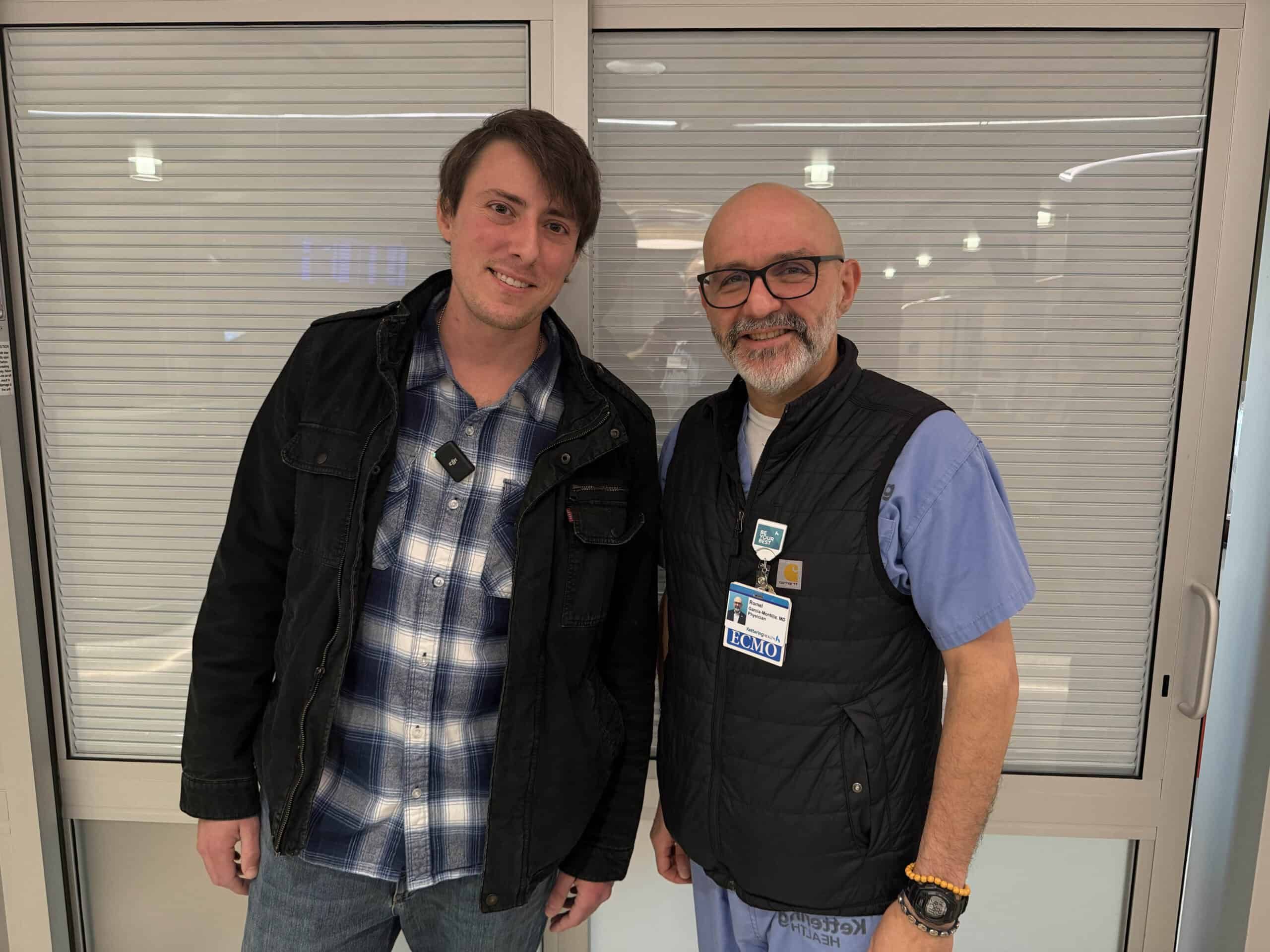
Because of Trevor’s unstable condition, Dr. Romel Garcia-Montilla, cardiovascular intensive care unit director, and Dr. M. Niranjan Reddy, an interventional cardiologist, decided to place him on extracorporeal membrane oxygenation (ECMO) support.
ECMO acts as an iron heart, taking blood from the heart, reoxygenating it, and returning it to the heart to keep it beating. At 35 years old and otherwise healthy, Trevor spent seven days on ECMO life support.
Grateful reflection
After a week, Trevor woke up in Kettering Health Main Campus. He had no idea what had happened after his seizure at Kettering Health Miamisburg.
His mom explained what he had missed. Trevor experienced cardiogenic shock, meaning his heart was unable to supply enough blood and oxygen to his body. He also experienced heart failure and severe blood clotting. The ECMO support kept Trevor alive, giving his heart the time to stabilize and recover.
“It made me feel very, very grateful for Kettering Health,” Trevor said.
Because of the lack of oxygen to his brain, Trevor experienced temporary memory loss after waking up, only remembering four months prior to the event. He also had to attend physical therapy to build his strength and relearn daily activities like walking, washing his hands, and brushing his teeth.
Today, Trevor is alive and well. Reflecting on how different the outcome could have been, he thanks Kettering Health for its quick action.
“If I had to go back in time to pick the right people and the right place,” he says, “I wouldn’t change anything at all.”