



Cancer Care
Want to learn more about this at Kettering Health?
In early 2024, Julie Michael received a letter from Kettering Health. She’d recently had her routine mammogram, the results of which always returned normal, unalarming.
Julie tossed the letter on the table, not concerned with it. But then she got a phone call. Julie was asked to schedule a follow-up ultrasound.
“I remember I asked them what for. And they said, ‘Your mammogram came back abnormal.’”
A change of plans
Even when scheduling her ultrasound appointment, Julie wasn’t concerned. She knew she had dense breast tissue. She knew that, sometimes, follow-ups were needed for women like her. Julie felt confident that the ultrasound would be clear and went to the appointment alone.
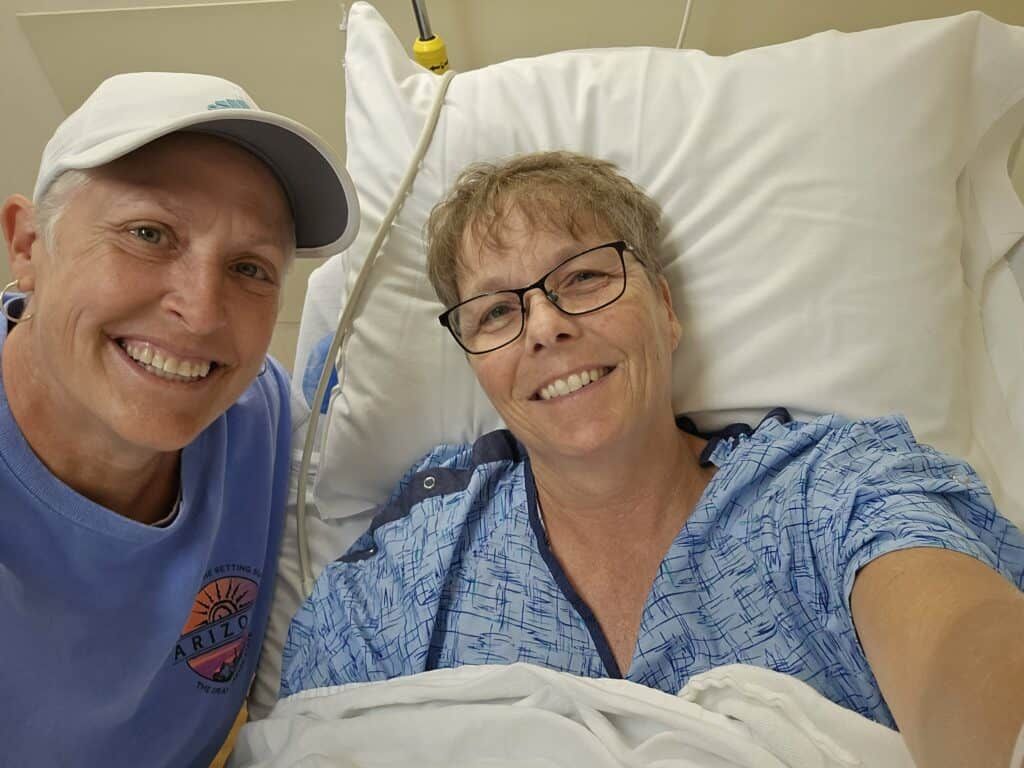
Afterward, she received another call. This time to schedule a biopsy. Julie’s friend insisted on going with her. It wasn’t until Julie was lying in the darkened room, in silence, with a biopsy needle in her left breast that she finally broke down.
“Things started spinning a little bit in my head.”
At the appointment to learn her results, Julie wasn’t sure what to think. She felt healthy. She took care of herself. She couldn’t imagine that cancer could be growing inside her. She was planning her early retirement. She knew what the next chapter of her life would look like.
The doctor scooted closer to Julie, putting his hand on her leg. “I’m sorry,” he told her, “but you have invasive lobular carcinoma in your left breast.”
“I don’t remember much after that,” Julie said. “I know my friend was there. She walked me to my truck. And I knew I needed to make phone calls. But I also knew that I couldn’t.
“I wasn’t able to talk.”
The right hands
Julie met Dr. Roxane Weighall, a surgical oncologist, and Dr. Alejandro Calvo, a medical oncologist. They answered question after question, no matter how many she asked. Her doctors and nurses took the time to thoroughly explain everything to her, making sure she understood every option available. She knew she was in the right hands.
“Almost like I was their only patient,” Julie said. “That’s how much effort and compassion they showed me.”
Because of the invasive nature of Julie’s cancer, Julie decided she wanted a double mastectomy. Additionally, a CT scan of Julie’s chest, abdomen, and pelvis was performed to determine if the cancer had spread.
The scan showed tumors in Julie’s abdomen.
Julie’s care team referred her to Dr. Rebecca Tuttle, a surgical oncologist, to treat the cancer in her abdomen. Dr. Tuttle initially thought the tumors were breast cancer that had spread. But further testing revealed it was something different.
Julie had a rare form of mesothelioma.
“They say God doesn’t give you more than you can handle,” Julie said. “But I thought in that moment, I’ve got two primary cancers. Not one, but two. And they’re both very bad.”
The only thing Julie knew to do was pray. She prayed for God to keep His hands on her care team and to give her the strength to fight. She would do whatever her team asked of her to walk her through this.
Julie’s watermelon moment
Julie’s abdominal cancer was slower-growing than her breast cancer, so her care team decided it was best to treat her breast cancer first.
Julie had a double mastectomy in June 2024, followed by 16 rounds of radiation in August.
There were days Julie struggled to hold onto hope. She’d wonder if she had the strength to continue. To carry her through the darkness, she surrounded herself with friends and family.
On one of those days, her friend, Elisa, came over. They joked about how good it would be to have some watermelon.
“It would be even better if it were already cut up and ready to eat,” Elisa added.
The day continued, and Julie’s hope slowly lifted, with a few more friends joining them. Her sister, Cindy, who Julie hadn’t planned on seeing that day, came over. She walked straight to the kitchen. A few moments later, she came out with a bowl of watermelon—cut up for everybody.
Julie looked around in astonishment, tears forming in her eyes. She asked Elisa if she had called Cindy and asked her to bring the watermelon. But she hadn’t.
“God cares about the little things,” Julie said.
Julie calls it her “watermelon moment.”
“God cares about watermelon. I’m worried about this deadly cancer, and God gave me a watermelon just to let me know He’s got me.”
A new plan
That October, Julie had surgery to remove the tumors in her abdomen. During the surgery, Dr. Tuttle treated Julie with hyperthermic intraperitoneal chemotherapy (HIPEC).
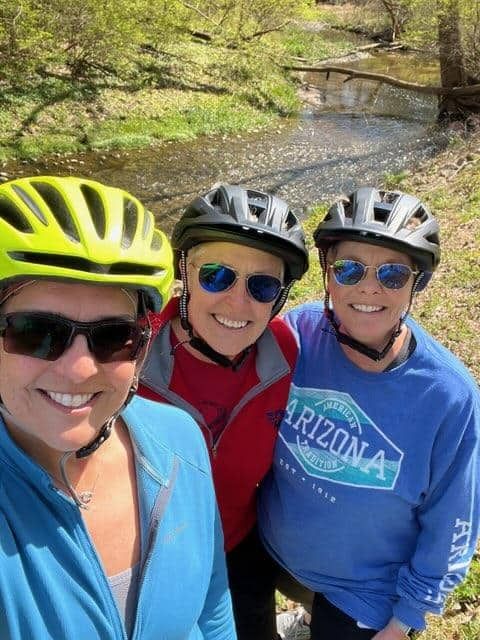
“Which, in layman’s terms,” Julie says, “is hot liquid chemotherapy that they pump through your abdomen for about 90 minutes.” This kills any remaining cancer cells.
Julie climbed a mountain she never intended to. And then she did it again.
All of her scans since have come back clear. Her plans look different than they did before her diagnosis. She might not get her early retirement, but she won’t let that hold her back from enjoying life.
“I’m still trying to figure it out. But I do know that it’s given me more insight and more courage,” Julie said. “I just want to live.”



