Heart and Vascular Care
Want to learn more about this at Kettering Health?
At a Glance
Q: How does ECMO help patients during serious heart failure?
A: ECMO provides temporary heart and lung support by circulating and oxygenating a patient’s blood. It keeps the body stable while doctors identify the cause of cardiac distress and plan treatment.
- ECMO is a support system, not a cure
- Used after major cardiac events or while awaiting surgery
- Includes sedation, monitoring, and a multidisciplinary team
Kettering Health Main Campus now has the system’s first extracorporeal membrane oxygenation (ECMO) machine, an iron heart acting as life support for patients in extreme cardiac distress.
What is ECMO?
The ECMO machine acts as an artificial heart, taking blood from one side of the heart, removing the CO2, reoxygenating it, and returning it to the other side of the heart. This keeps the heart beating.
ECMO is not used as a treatment, but as a support system used after someone experiences extreme cardiovascular distress. This gives the heart enough time to recover for surgery, or the care team extra time to determine the cause and best course of action for the patient.
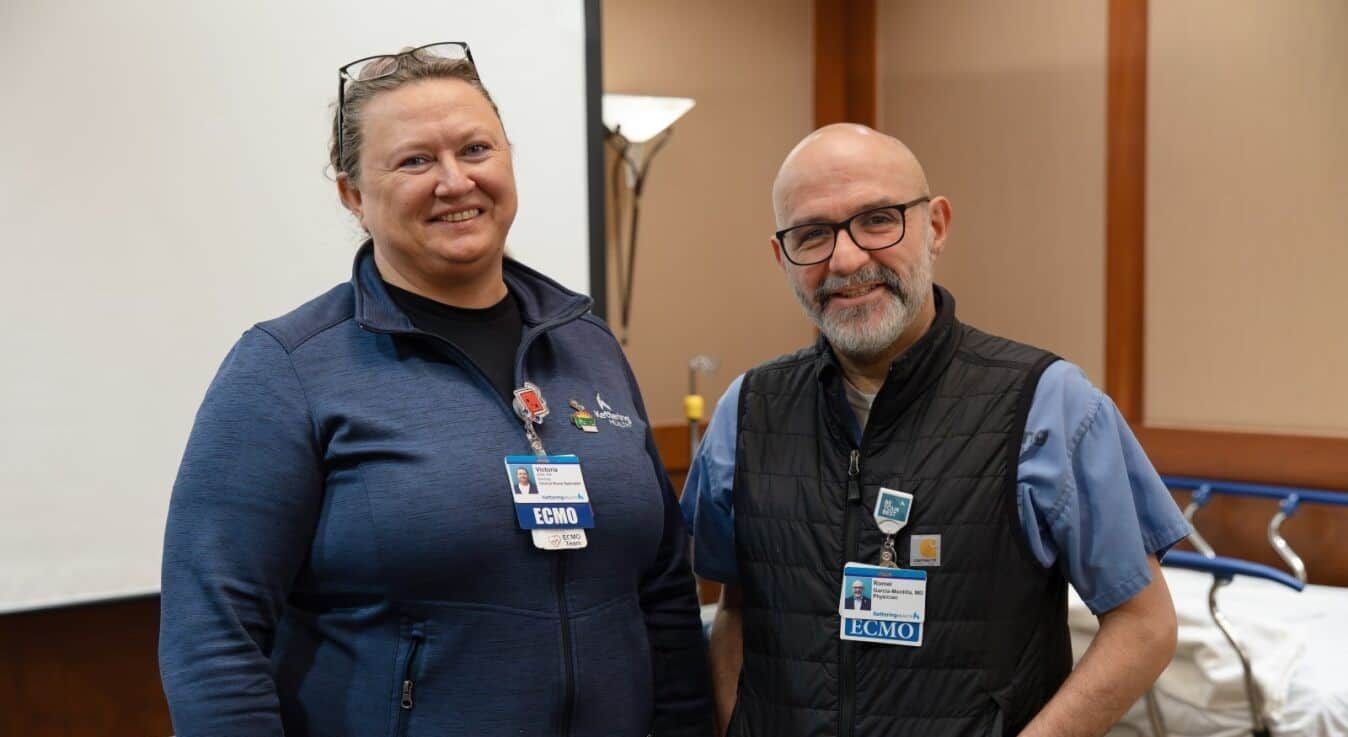
“We can actually put the patient on support and give the heart time to recover, or give the physician the time to figure out what’s going on,” Victoria Long, ECMO program coordinator, says. “So this is going to be the last step, the life support.”
Sometimes, ECMO is used as life support as a patient awaits an organ donation.
What can patients expect from ECMO?
Typically, ECMO supports patients for anywhere from one to three weeks.
To make it safer to connect the machine to a patient’s heart, either through the neck or the groin, the care team usually sedates patients at the beginning of the process. From there, it’s a case-by-case basis on how much sedation a patient needs.
“We try to keep the patient as awake and as mobile as possible,” says Dr. Romel Garcia-Montilla, cardiovascular intensive care unit director and ECMO program medical director at Kettering Health Main Campus.
Even when sedated, the team monitors the patient’s brain waves to continually adjust the level of sedation best for them.
How ECMO is moving heart care forward
Even though the mechanics of ECMO are straightforward—circulating a patient’s blood through a system that removes carbon dioxide and restores oxygen—an entire care team is needed to keep the patient safe.
“We’ve taken a select number of critical care nurses and trained them with this new special skill to run the ECMO pump, then it still requires another ICU nurse to care for the patient, and a respiratory therapist, and then a doctor like Dr. Garcia-Montilla,” says Kevan Quinlan, administrative director of nursing and critical care services. “So it’s a big, multidisciplinary group that helps care for this very delicate patient.”
Kettering Health’s goal is to continually advance its heart and vascular care, and Kevan says obtaining ECMO support helps achieve that goal. Patients who need this support no longer need a referral somewhere else.
“This is one spoke in the wheel—a big spoke—in increasing our cardiovascular capabilities. It’s just another step into a stronger and more robust cardiovascular program at Kettering Health.”
Learn more about Heart and Vascular Care at Kettering Health.
Learn morePeople Often Ask
Most patients stay on ECMO for one to three weeks. The care team adjusts support based on how well the heart is recovering and what the underlying condition requires.
ECMO is typically connected through large blood vessels in the neck or groin. The team uses sedation at first to place the lines safely, then adjusts sedation based on the patient’s needs.
Many patients are kept as awake and mobile as possible once ECMO is running. Sedation levels are monitored and adjusted using brain‑wave tracking to ensure comfort and safety.
An ECMO patient is supported by a multidisciplinary team. This often includes trained critical care nurses, ICU nurses, respiratory therapists, and heart specialists who monitor the machine and the patient around the clock.
ECMO is used when the heart or lungs are too weak to work on their own. It gives the care team time to diagnose the problem, plan treatment, or support a patient while waiting for surgery or organ transplant.