Cancer Care
Want to learn more about this at Kettering Health?
At Kettering Health, we know that cancer is personal, and there’s no one-size-fits-all approach to diagnosis and treatment. That’s why we’re focused on new and innovative technology to provide the best care to every patient.
Diagnostic tools
Cancer Risk Assessment
Our Cancer Risk Assessment estimates a person’s likelihood of developing certain cancers by evaluating information such as personal and family medical history, genetic factors, lifestyle, and previous cancer screening results.
This helps determine appropriate cancer screenings for patients based on their personal cancer risk. The knowledge from the Cancer Risk Assessment also helps our providers guide patients in preventative lifestyle and medication changes.
“The biggest benefit is that it can turn information about cancer risk into actionable care,” says Raenell Poynter, APRN-CNP.
Dueta™
Dueta is a patient-assisted compression device used during mammograms to give patients control and enhanced comfort during their screening. To do so without sacrificing clarity and quality of the image, the mammography technologist positions the patient and begins compression until the “minimum allowable amount” of compression, allowing the patient to continue compression with a remote after that point.
“Adequate compression is key to good images and diagnosis,” says Deanne Rose, Kettering Health Breast Centers director. “It is proven that patients have allowed better compression when they control it themselves, leading to a more comfortable mammogram.”
Ivena™ Automated Breast Ultrasound
The Invenia Automated Breast Ultrasound (ABUS) screening uses sound waves to create clear 3D images that help radiologists find cancer hidden in dense breast tissue. The images from the ABUS screening are reviewed along with a patient’s mammogram, providing a more comprehensive evaluation for women with dense breast tissue.
Lunit
Lunit uses artificial intelligence to help radiologists identify suspicious areas on mammograms that may need closer review. Lunit’s technology also helps mammography technologists evaluate breast positioning and compression to support consistent, high-quality images.
In addition, it provides an objective measurement of breast density, which can help the care team assess breast cancer risk and determine whether additional screening may be appropriate.
Contrast-enhanced Mammography
Contrast-enhanced mammography (CEM) combines mammogram images with an iodine-based contrast agent given through an IV. The contrast helps highlight areas of increased blood supply that may be associated with breast cancer, providing radiologists with information beyond a standard mammogram.
Our care teams review each patient’s history and imaging needs to determine whether CEM is appropriate.
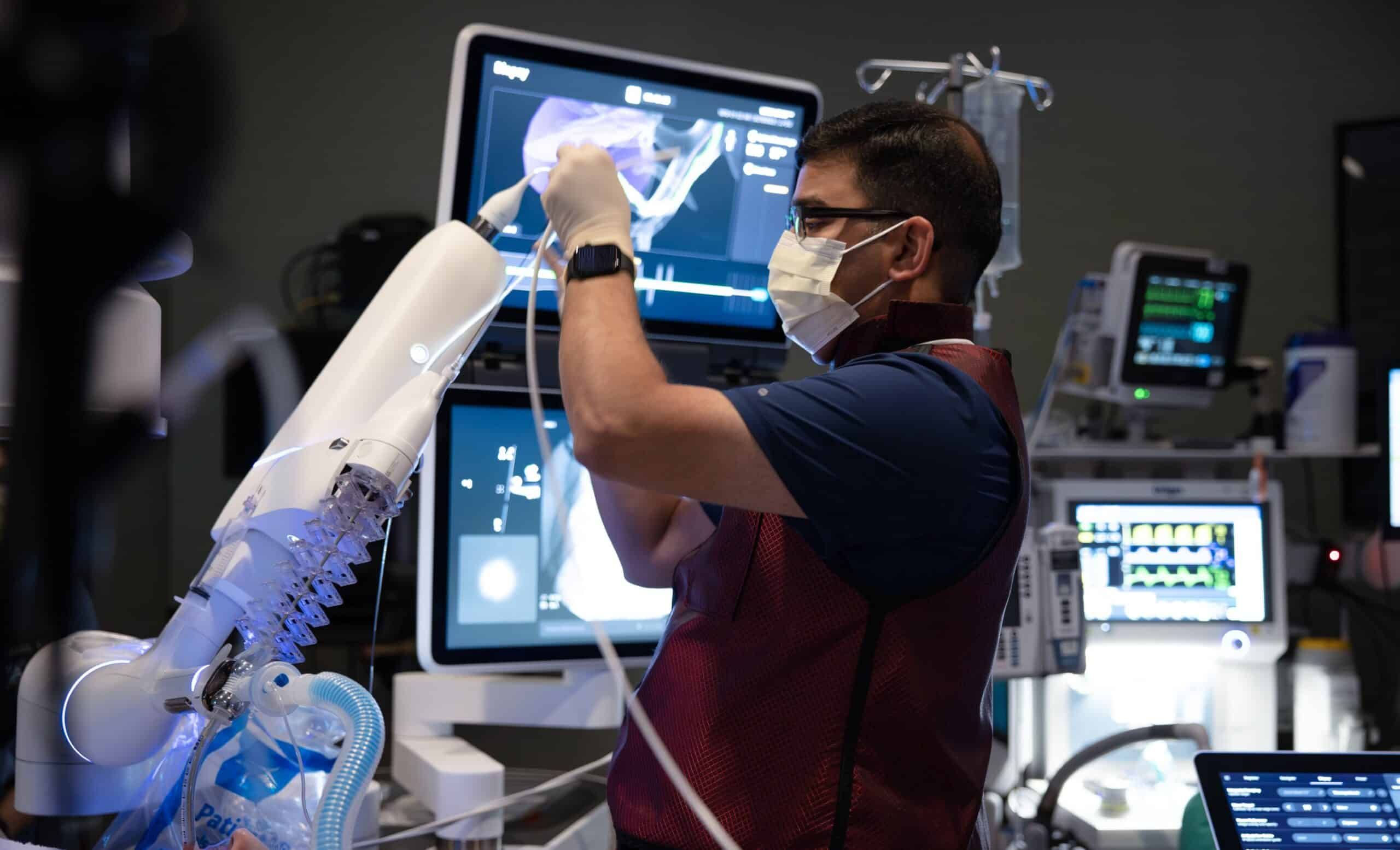
ION Bronchoscopy
ION Robotic Bronchoscopy can precisely biopsy small lung nodules that are often difficult or impossible to reach with traditional bronchoscopy, resulting in earlier diagnosis and more treatment options for patients. More than 60% of lung biopsies found to be cancerous with the ION robotic bronchoscopy were diagnosed early in stages one and two.
“That has led to the quicker treatment of these patients,” says Dr. Ravi Desai, a pulmonary specialist.
ClearRead™ AI
ClearRead AI is an AI software that helps radiologists interpret chest X-rays and CT scans. The platform is particularly helpful in identifying lung nodules and other abnormalities in scans.
“This technology has the potential to support earlier lung cancer diagnosis by helping identify suspicious nodules that may warrant further evaluation,” says Tricia Tobe, executive director of oncology services.
Treatments
Histotripsy
Histotripsy is a noninvasive procedure used to treat liver tumors. Unlike surgical options, histotripsy uses high-energy ultrasound waves to destroy tumors. Because of its precise targeting, this technology has the ability to treat tumors located near major blood vessels or bile ducts without injuring those structures. Histotripsy is also effective at treating smaller liver tumors.
“It is a type of treatment that is able to treat tumors that we would not otherwise be able to treat,” says Dr. Jing Li Huang, a surgical oncologist.
Gamma Knife®
At Kettering Health, we use the latest Gamma Knife platform, the Icon™ system, which delivers about 200 beams of low-dose radiation from multiple angles to destroy a brain tumor without harming surrounding tissue. This technique, known as stereotactic radiosurgery, is noninvasive and one of the most precise and recognized treatments for brain tumors.
Low Dose Radiation Therapy
While radiation is primarily used as a cancer treatment, Kettering Health also uses low-dose radiation therapy (LDRT) as a targeted treatment to help reduce pain and slow down the progression of certain non-cancer inflammatory conditions. LDRT is a noninvasive option for patients who have not found relief from traditional treatments such as medications, injections, or physical therapy, or who are not candidates for surgery.
Cancer is personal
We know that everything can change when you have cancer. That’s why we’re here with the most advanced treatments available and a team of specialists committed to getting you back to what you love most.