



Brandi Carlin is standing with her back pressed against the wall of a Dayton Children’s operating room (OR). More than 30 team members are crammed inside. It’s a cool November day in 2021, but the air in the room is charged.
Brandi’s trying to stay out of the way—for now. She watches Dr. Akil Patel, a Kettering Health vascular neurosurgeon, closely, anticipating his next need as he operates on the patients.
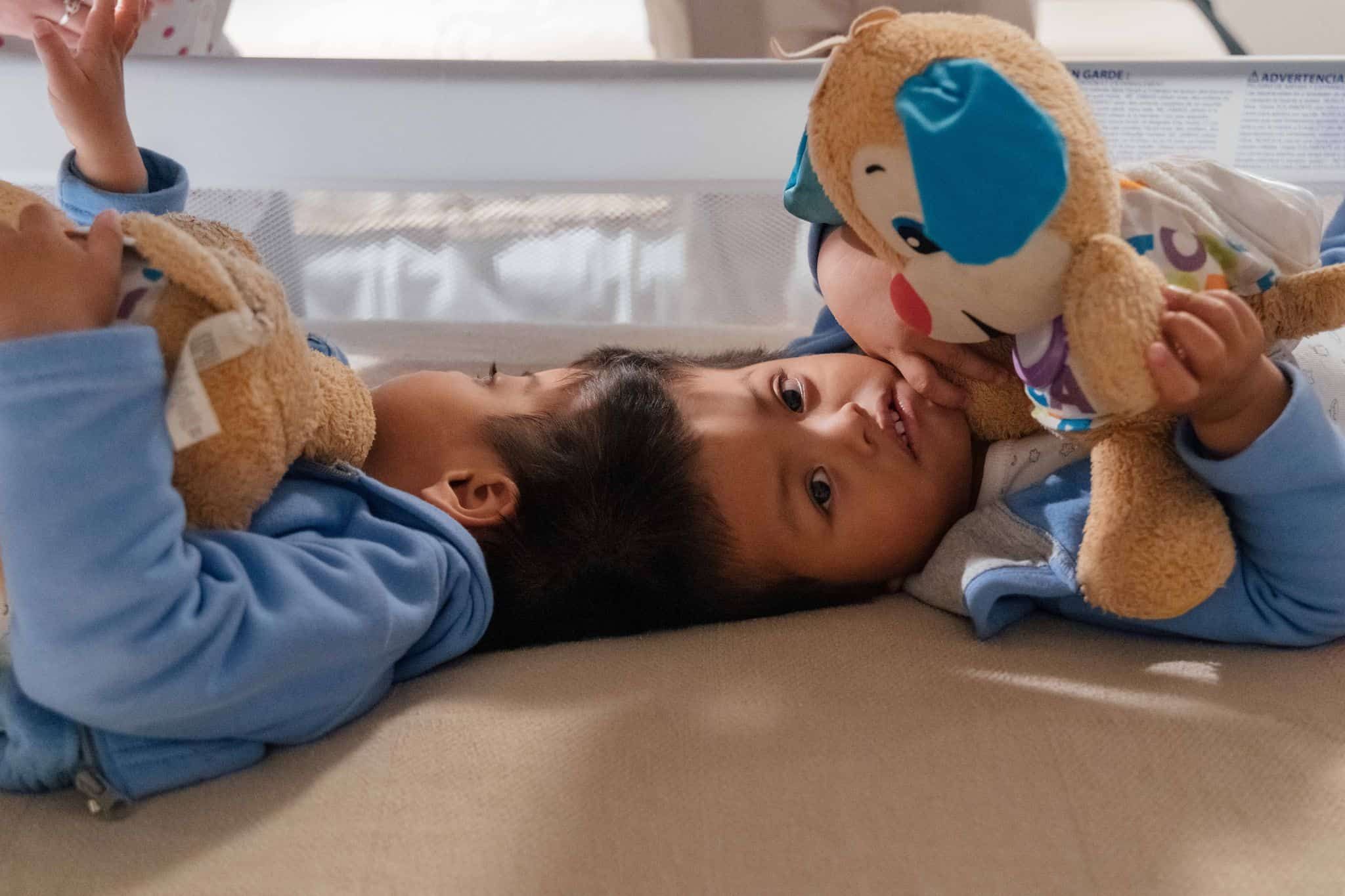
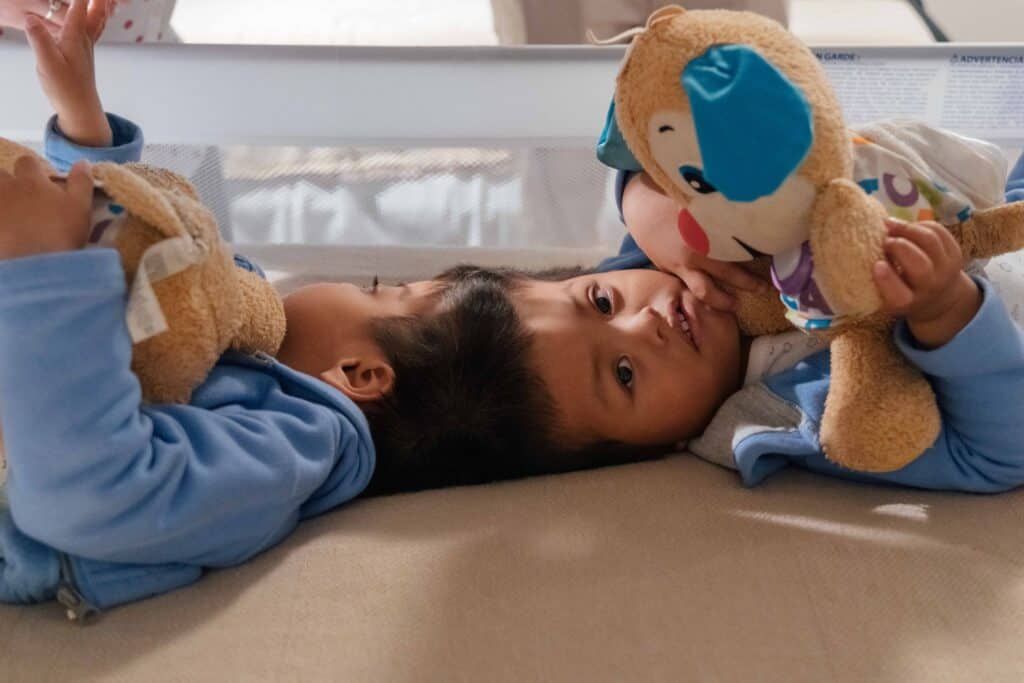
Yes, there are patients—plural—on the operating table: Pedro and Augusto, three-year-old craniopagus (conjoined at the head) twins from Guatemala.
“Seeing their tiny toes and fingers was not easy,” said Brandi, a new mom at the time. “After [taking] a few moments to see the reality of what was in front of me, I embraced my ‘mom hat’ and thought ‘I’m going to do everything I can to help these kids.’”
Brandi is part of the team of four employees—including three angiography technologists (angio techs) and an interventional radiology supervisor—from Kettering Health Main Campus who supported the twins’ surgeries at Dayton Children’s.
The call

A year earlier, Dr. Patel received a phone call from Dr. Robert Lober, a pediatric neurosurgeon at Dayton Children’s. Dr. Lober and his colleague Dr. Christopher Gordon, a craniofacial surgeon, were preparing to do what seemed impossible: separate Pedro and Augusto.
And they needed Dr. Patel’s help.
Pedro and Augusto lived conjoined at the tops of their heads and shared major blood vessels. The twins’ situation was, by all accounts, rare. And safe separations are even rarer.
After days of deliberating, Dr. Patel had an answer. “I think we can do this,” he told Dr. Lober.
Dr. Patel assembled his team of support from the KH Main Campus Angiography Department. Angio techs Brandi Carlin, Josh Adams, and Tyler Farr, and interventional radiology supervisor, Nate Pahl.
Essential support
In a complex case like this, the roles of the medical staff are equally complex—and critical. Angio techs scrub in for procedures to anticipate and support surgeons’ needs while simultaneously operating an X-ray machine, called a fluoroscopic C-Arm, to visualize and guide wires, catheters, or drains into the desired anatomy of the patient. This process is more simply referred to as an angiogram.
Being chosen by Dr. Patel to support such a rare, complex case was significant.
“It was very meaningful to be selected by Dr. Patel to be involved in this surgery, and it speaks to the professionalism and technical expertise of the KH Main Campus team of angio techs,” said Nate.
It’s uncommon for angio techs to have the clinical experience for complex neurointerventional procedures. Luckily, their team is specifically trained for them because they work with neurosurgeons like Dr. Patel and Dr. Peter Bouz.
Nate, Brandi, Tyler, and Josh spent the next year alongside Dr. Patel and the Dayton Children’s team preparing for the series of four separation surgeries.
Meticulous prep
Nate worked closely with Dayton Children’s Radiology and OR leadership teams to determine the specialized equipment needed for the intraoperative cerebral angiogram procedures.
If a specific piece of equipment is needed during a surgery at KH Main Campus, they can walk across the hall to retrieve it. That wouldn’t be possible at Dayton Children’s, because they don’t perform cerebral angiography procedures.
“Nate Pahl was very instrumental in ensuring that the proper products and equipment were present at Dayton Children’s,” said Josh. “It required a considerable amount of time and effort, but it was necessary. No detail was overlooked—we had what we needed, when we needed it, every time.”
Tyler and Brandi helped plan for the surgeries by performing the diagnostic angiogram in the interventional lab. “We obtained access from the femoral artery and followed up until we reached the internal carotid artery,” Brandi explained. “This is where Dr. Patel and Dr. Lober could obtain ‘gold standard’ imaging (as opposed to MRI/CT), to view how the vessels flowed through each child and how they shared blood flow.”

There was no room for mistakes—every single moment of focus, expertise, and collaboration mattered.
Collaboration fit to beat the odds
Josh supported three of the four surgeries, understanding that what lied before them was an unprecedented case.
Of the 50 or so craniopagus twins born each year, only 30% survive beyond a few months. The boys had already beaten those odds. But between developmental delays and organ issues, their chances dwindled.
Tyler supported the second and fourth surgeries. He felt confident in the team’s ability and role in the procedures. “We were dealing with a case that was more complex than what we are normally used to, but the basics are still there, and we knew exactly what we had to do,” he said.
Beyond his prep involvement, Nate also participated in the first, third, and fourth surgeries. Brandi supported all four.
This group was just a small piece of the highly skilled, diverse team fighting to save the twins’ lives.
“When you step in the OR, you become one big team and you know what everyone’s role is,” said Tyler. “Communication is key because you need to know immediately if anything is going wrong.”
Brandi described it well. “In the OR, you can tell when the surgeons are at a critical moment. The chatting and joking stop. It gets quiet,” she said. “You become hyperaware of your surroundings and start thinking about what the next step is.”
For support staff, that’s a constant mentality. ‘What’s the next step?’ If they need me to jump in, where are the gowns, gloves, crash cart? Fortunately, those moments were rare,” she explained.
One miracle becomes two
The final surgery began on April 5, 2022 at 11 p.m. It was a 360-degree separation of the boys’ brains—and lives.
Nate and the angio techs split into pairs, each supporting a different day to keep their eyes and minds fresh for the multi-day procedure.
On Friday, April 8 at 5:43 a.m., after 54 hours and 43 minutes of operating, Pedro and Augusto were safely separated.
Nate, Josh, Tyler, Brandi, Dr. Patel, and the Dayton Children’s team united to change the trajectory of two three-year-old boys’ lives, and together, accomplished the impossible. “The outcome itself is nothing short of a miracle,” said Josh.