



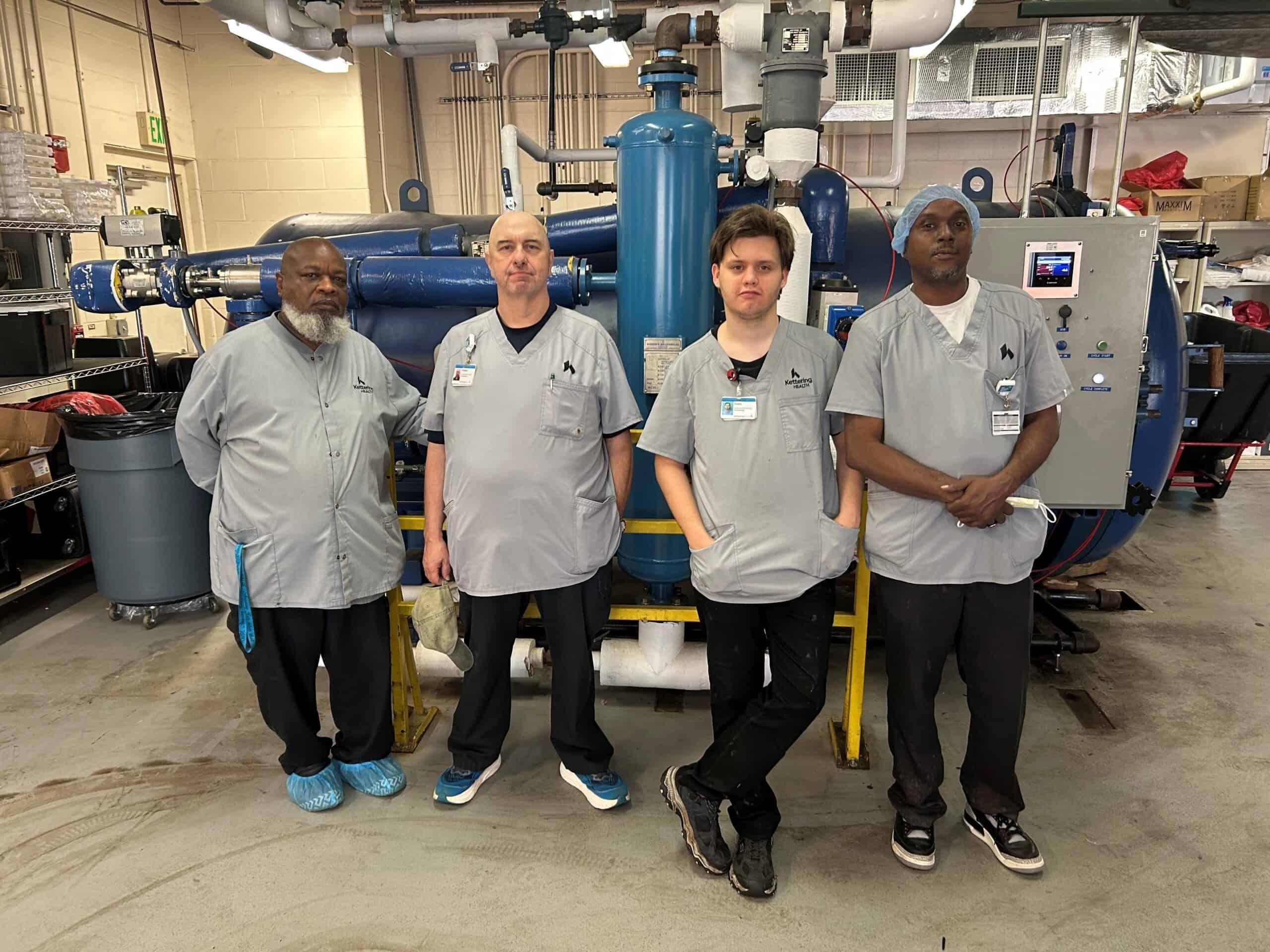
Environmental Services staff at Kettering Health’s Main Campus handle one of the most essential and least visible parts of hospital operations: waste collection.
From regular trash to bio-waste and soiled linens, the work is constant. It is also physically demanding and plays a direct role in patient safety.
“This is not a job for everyone,” first-shift supervisor Jackelyn Akemon said. “Everybody doesn’t want to smell that all day long. But our guys, they’re on top of it and they’re all doing a great job.”
The team operates around the clock across a large campus where the workload can shift quickly based on daily activity.
“There’s no predictability pattern,” said Harrison Wang, the manager of Environmental Services at Main Campus. “One day the census might be over 400, and the next day the census might be 300. So, you’re losing 25% of your volume.”
Those swings directly affect how much waste the team handles and how quickly it must be managed.
Wang said the team relies on communication from hospital departments to stay on pace.
In many cases, one person is responsible for handling trash during a shift, moving across the facility to manage collection points and respond to requests. The work includes monitoring trash chutes, replacing full carts and transporting waste to compactors. It also requires careful separation of materials, particularly when handling regulated medical waste.
“The biggest difference that we have is between the bio-waste and the trash,” Wang said. “There are just times where some bio waste goes into the trash can, which, then, instead of separating it, because we don’t know what patients have, we just put it all in a red bag. Once it’s tainted with bio waste, it is bio waste.”
Leaders said those decisions are critical to infection prevention and overall patient safety.
At the Main Campus, the volume of regulated medical waste is substantial.
“We average approximately 87,000 pounds a month of waste, regulated medical waste,” said Melvin Crawford, executive director of Environmental Services.
The work is physically demanding and often involves moving large waste containers in tight service areas.
“These waste containers can be hundreds of pounds to move around, and we don’t want to have an injury or strain,” Crawford said, adding that leaders are exploring ways to improve safety and reduce that physical burden. “Anything we can do to reduce that strain helps protect our team.”
For staff, the work can often go unnoticed, despite its importance. Even so, Akemon said the team remains committed to doing the job well.
“They make sure that they have all the PPE and things that they need to be able to do their job, and they like what they do, and they all do take pride in the work that they’re doing,” Akemon said.
Within Environmental Services, leaders emphasize supporting staff and recognizing their contributions.
“We’re invested in our team and their successes, their highs, their lows,” Wang said.
Crawford said the work also reflects Kettering Health’s mission to live God’s love by promoting and restoring health.
“For us, reducing infections is directly connected to our mission,” he said. “Everything we do, even behind the scenes, supports patient healing.”
He said the impact of the team’s work shows up in patient outcomes.
“If we’re doing our job well, hospital-acquired infections will go down quite a bit,” Crawford said.
The goal is consistent: maintain a safe, clean environment that supports patient care.