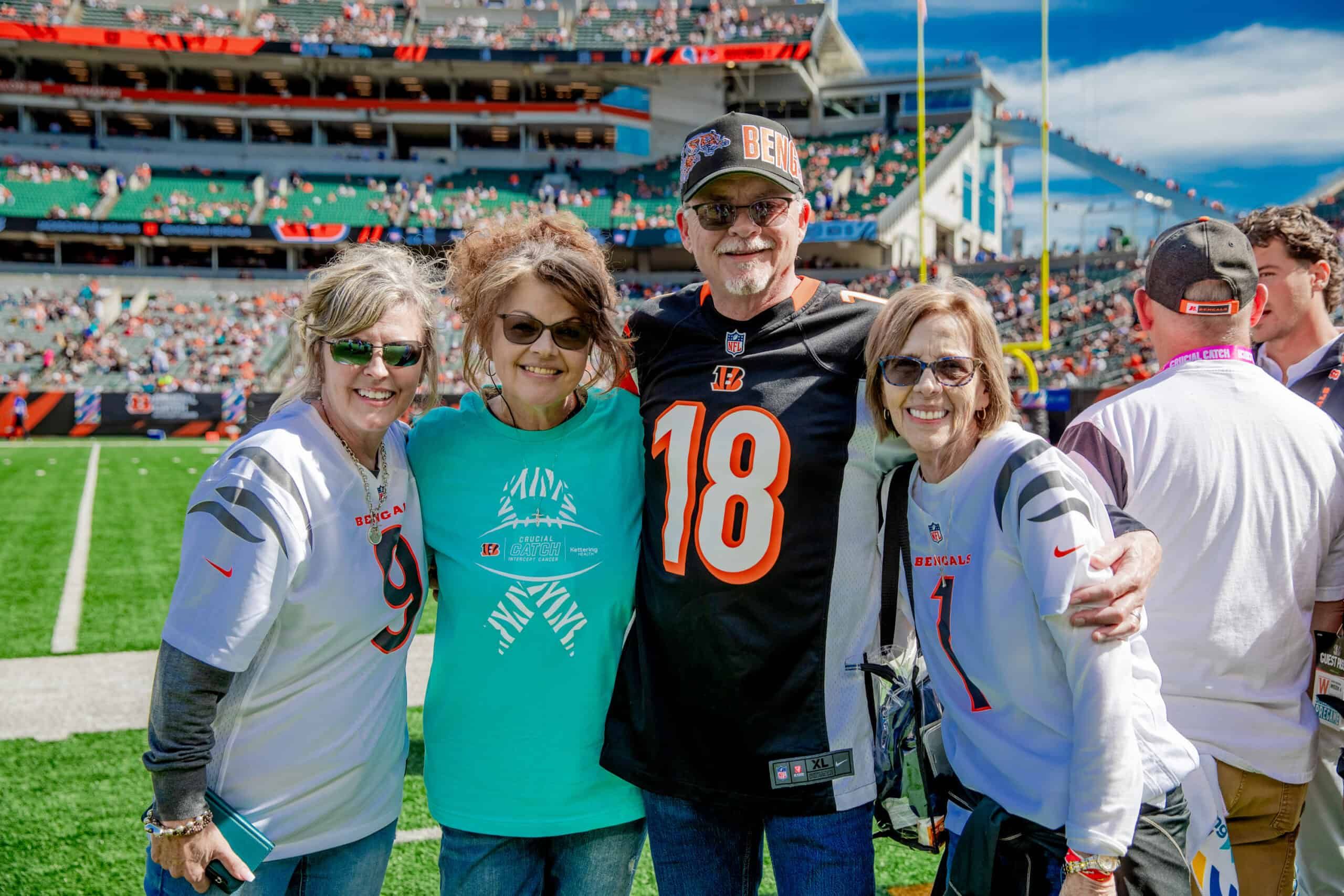
When Kendra Wilson stepped onto the field at Paycor Stadium to sing the national anthem before the Cincinnati Bengals’ Oct. 4 Crucial Catch game, she expected an unforgettable experience.
Wilson earned the opportunity through an internal Kettering Health contest tied to the Bengals’ annual Crucial Catch initiative. Joined by her husband, Ron, her mother, Cheryl, and her sister, Alicia, she spent the day behind the scenes at the stadium before performing in front of more than 60,000 fans.
“I looked up in the stands and thought, ‘You know what? These people are all just fans like me,’ ” said Wilson, manager of onboarding and transitions for Kettering Health Medical Group. “I took a big deep breath, and we just let it rip. I wasn’t nervous at all.”
Sharing the experience with her family proved just as meaningful.
“My mom hugged me and said, ‘If I forget to tell you later, I can’t thank you enough for bringing me. This is one of the top five most special moments of my life,’ ” Wilson said.
While singing the anthem was a lifelong dream, the experience left a lasting impression in another way.
The attention surrounding the Bengals’ Crucial Catch experience, from media coverage to conversations with coworkers, friends and community members, prompted Wilson to reflect on a cancer journey she had long viewed differently than many other survivors.
Diagnosed with cervical and uterine cancer at age 28, Wilson credits early detection with saving her life. Because her cancer was caught early, surgery was her only treatment, a contrast she often drew between her experience and those of patients facing ongoing cancer battles.
Among the many moments that reinforced that perspective was reconnecting with the physician who diagnosed her cancer 30 years ago. After the game, Wilson sent the physician a link to her Channel 12 interview.
“I sent her a link and said, ‘You won’t remember me, but 30 years ago you were my primary care provider, and you saved my life,’ ” Wilson said. “She wrote me back and said, ‘I’m so glad you’re thriving.’ “
The experience helped Wilson realize that her story still has value, not because it represents the most difficult cancer journey, but because it demonstrates the impact early detection can have.
“I’ve learned a new perspective that even though it was 30 years ago, it’s still valid and it still matters,” Wilson said. “Young, particularly young men and women, need to hear it.
“I now have the responsibility of being an advocate for those who may need a push or need to understand how early detection can save your life.”