



Fatigue, stress, fear, and frustration are some of the feelings faced by us, our patients, and their families. Amid those challenges, how do we come together to carry out our mission?
The answer is resilience. We can be resilient by
- Leaning on our teammates for support.
- Resting and recharging when we’re not at work.
- Learning from experience.
- Remaining hopeful and trying not to dwell on the negative.
- Being proactive and seeking out help when needed.
Great Catches
A Great Catch is when someone proactively prevents harm from reaching a patient. Kettering Health uses safety events reported through Great Catches and SAFE events to make positive changes and improvements across the system.
Great Catches are celebrated each day during campus Daily Safety Briefings. Please share your Great Catches with your leader, so your commitment to patient safety can be recognized.
- Thank you, Ryan Kline from the Cath lab at Kettering Health Dayton, for your Great Catch. Ryan had an order for IV piggyback Methocarbamol, which is not a normal route for this medication. When Ryan pulled it from the Omnicell drawer it was a reconstitution vial with sterile water. The medication was Methohexital, a paralytic, instead of Methocarbamol. Ryan called the pharmacy to question the route and inquire why Methohexital was not only in the Omnicell but also in the incorrect bin. Pharmacy was notified and the Omnicell has been taken care of.
- Thank you, Tammy Coates at Kettering Health Dayton, for your Great Catch. Tammy received a patient from the Post Anesthesia Care Unit (PACU) and while performing the four eyes assessment, Tammy found a syringe of Fentanyl with a blunt needle attached in the bed with the patient. Tammy promptly removed it and followed up with the PACU.
- Harjeet noticed the nurse practitioner had ordered blood cultures but there was no indication for them since the patient was admitted for heart problems. Harjeet addressed the concern with the nurse practitioner and the order was cancelled.
Medication Safety: BCMA Warning Alerts
Bar Code Medication Administration (BCMA) systems have shown to prevent wrong medication or wrong patient events, improve operational efficiencies, reduce preventable medication errors, and reduce potential adverse events. BCMA systems can improve medication safety by verifying that the correct medication and dosage is being administered to the intended patient.
At Kettering Health, the BCMA technology is available in the emergency areas, oncology infusion areas, and the inpatient areas. In those areas, patients and medications require scanning prior to the administration of medications. Nursing leaders are required to review and share BCMA scanning results with their staff on a routine basis.
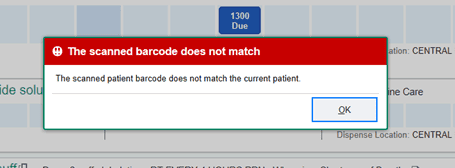
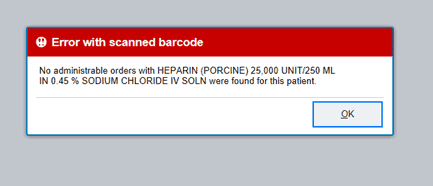
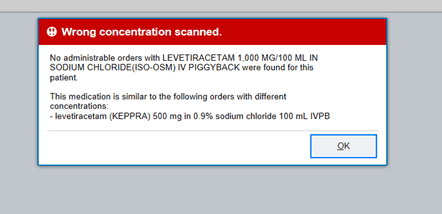
The BCMA system will identify if the wrong patient, medication, or concentration is scanned and trigger a warning alert. See below for examples of each situation.
- Wrong patient scanned:
- Wrong medication scanned:
- Wrong concentration scanned:
ex. Keppra 500mg IV is ordered but Keppra 1000mg IV is scanned:
What should you do when you see these errors? To ensure medication safety is adhered to, please perform the following steps:
- STOP.
- Exit the Epic chart and close all other open Epic charts.
- Identify the patient with two verifiers. Scan the patient’s label bar code and review to ensure the correct Epic chart opens.
- Review active medication orders to ensure the medication you intended to give is still appearing on the MAR.
- Verify the medication label for the patient’s name, and medication name and strength.
- Scan the medication bar code to see if alerts appear in Epic.
If the wrong patient, medication, or concentration alerts are still appearing after performing the above steps and you cannot determine why, it is imperative to:
- Notify your nurse leader immediately to identify why and where the error is occurring.
- STAT call to IS Helpdesk ext. 44500 to further assist in addressing scanning issues or hardware issues such as broken scanners.
- Call inpatient pharmacy if medications are triggering scanning errors.
Please commit to safety in your daily workflow by ensuring to scan before medication administration. It’s vital to pay close attention to BCMA wrong patient or wrong medication alerts and to carry out the appropriate steps to ensure the safety of our patients.
Infection Prevention: Personal Protective Equipment (PPE) in Isolation Rooms
The infection prevention and control department is continuing to observe many incidences of staff/providers not wearing the necessary PPE in patient isolation rooms. Studies have shown organisms can live for an extended amount of time on surfaces, can be transferred to healthcare worker’s clothing up to 79% of the time, and can serve as a source of indirect transmission of microorganisms to our patients, co-workers, loved ones at home, and even ourselves. Wearing all the appropriate PPE for all patient isolations is an essential part of keeping everyone safe from the spread of infectious diseases and needs 100% compliance from all staff and providers. Thank you for your cooperation.