


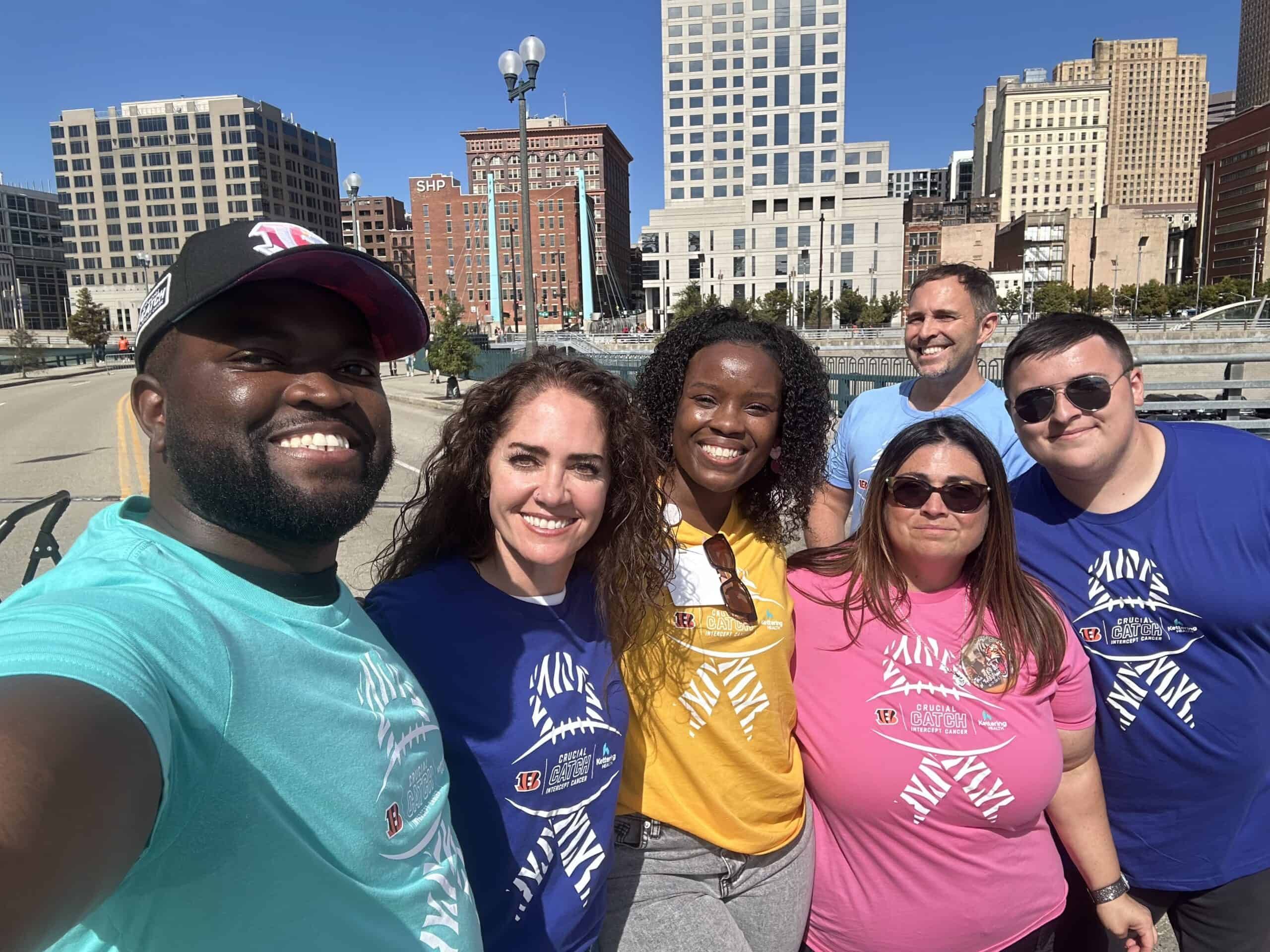
Thirteen years after losing her brother to cancer, Lindsay Duvall wrote his name on a flag during the Cincinnati Bengals’ annual Crucial Catch game at Paycor Stadium.
Around her, Bengals and Jacksonville Jaguars fans were doing the same, honoring loved ones, survivors and others affected by cancer.
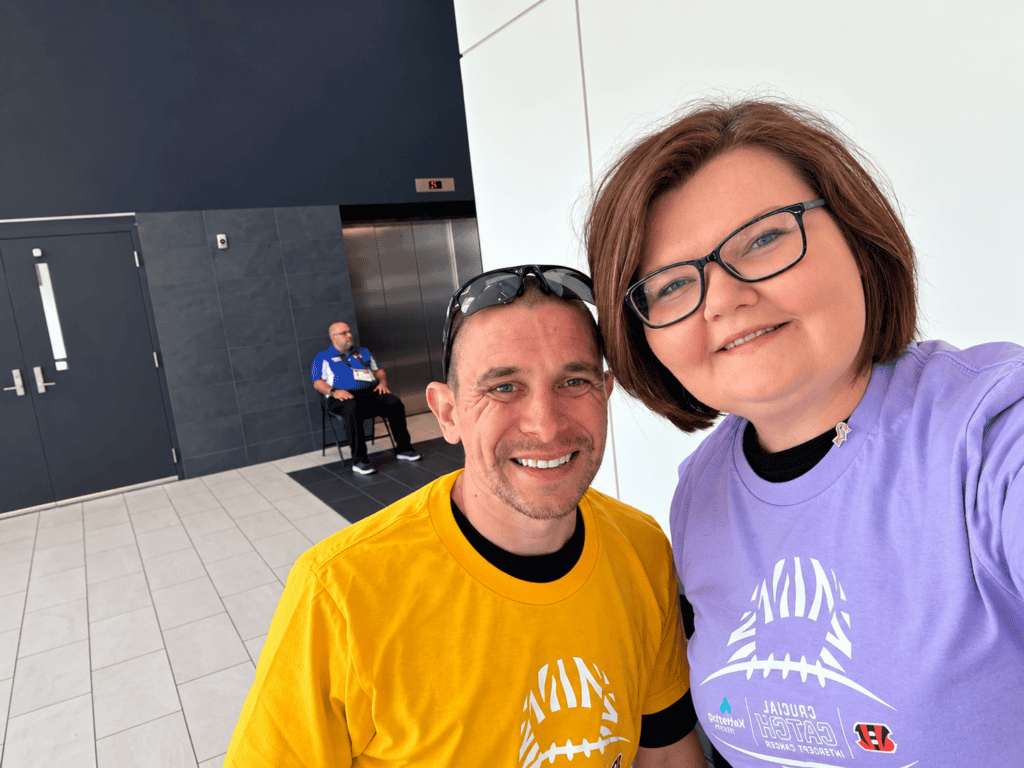
For Duvall and fellow Kettering Health employee Christina Lucas, volunteering at the Oct. 4 event was about more than supporting a community partnership. One volunteered to honor a brother lost to cancer. The other returned as a survivor determined to support others facing the disease.
Their experiences inspired them to volunteer during the Bengals’ annual partnership with Kettering Health, which promotes cancer awareness, early detection, patient support and remembrance.
Duvall, a medical assistant at Years Ahead, said volunteering took on special meaning because her brother was a lifelong Bengals fan and season-ticket holder who died from cancer 13 years ago.
“This is really something near and dear to my heart because my brother passed away from cancer,” Duvall said.
The experience became even more meaningful when she and her son, Avery, were able to add her brother’s name to a commemorative flag.
“We got to sign my brother’s name on the flag and represent him while we were down there,” she said.
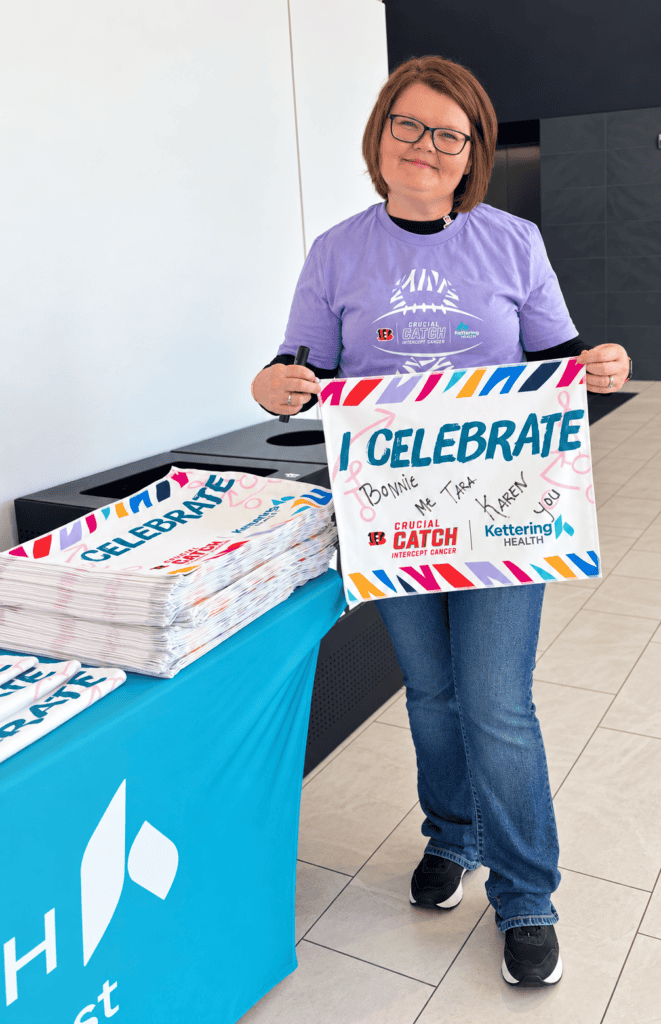
Throughout the day, Duvall helped fans write the names of friends and family members affected by cancer on rally flags displayed during halftime. She said one of the most memorable parts of the experience was seeing supporters from both teams unite around a cause that affects so many families.
“Cancer doesn’t discriminate. It doesn’t care what football team you’re for,” Duvall said.
For Lucas, a medical office assistant who has worked at Kettering Health for 22 years, volunteering offered an opportunity to connect with others whose lives have been touched by cancer.
A cancer survivor, Lucas volunteered alongside her husband at Crucial Catch for the second consecutive year, helping distribute rally towels and speaking with fans who stopped to share their own stories.
“What it means to me, it’s just getting to hear those stories,” Lucas said.
Asked what message she hopes people take away from Crucial Catch, Lucas didn’t hesitate.
“Early detection most definitely,” she said. “And then always have your support.”
Both employees said they would welcome the opportunity to volunteer again.
For Duvall, the event provided a meaningful way to honor her brother’s memory. For Lucas, it was an opportunity to support survivors, caregivers and families facing challenges similar to those she experienced herself.
“They don’t have to do it alone,” Lucas said.
Editor’s note: After volunteering at the Bengals’ Crucial Catch game, Christina Lucas shared a personal reflection about the experience, and the impact cancer has had on her life and family. Her reflection appears below.
What the Crucial Catch Game Means to Me
Sometimes people see an event.
They see the crowd.
They see the colors.
They see the towels being handed out.
They see the smiles, the pictures, and the celebration.
But when I look around at the Crucial Catch game, I see stories.
I see people who have heard words they never wanted to hear.
“You have cancer.”
I see people who have sat in waiting rooms praying for good news. I see families who have held hands through treatments, surgeries, scans, and sleepless nights. I see survivors who have fought battles most of us will never fully understand.
And when one of them stops to tell me their story, something inside of me changes every single time.
Because they don’t have to tell me.
They don’t have to let me into one of the hardest chapters of their life.
But they do.
Sometimes I am standing there listening to someone I may never see again, and within minutes they are telling me about the day they were diagnosed, the treatments they endured, the people who stood beside them, and the moment they finally heard the words they had prayed so desperately to hear:
“You are cancer-free.”
How do you hear something like that and just walk away unchanged?
I can’t.
Their stories stay with me.
Some have brought tears to my eyes. Some have brought my husband to tears. Some have reminded me just how precious another birthday, another Christmas, another football game, another hug, and another ordinary day really are.
And maybe that is why Crucial Catch has become so personal to me.
Cancer isn’t just something I have heard about.
It has touched people I love.
When I was younger, after having my first child, I experienced a health scare that made me realize how quickly life can change. I remember the fear and uncertainty of waiting for answers, wondering what the future might hold.
I prayed and prayed, and after more testing, I was grateful to learn that everything was okay.
That experience stayed with me. It taught me not to take my health, my family, or another ordinary day for granted.
When you are young, you don’t expect to face fears like that. You don’t expect your mind to suddenly race ahead to all the what ifs.
What if it happens to me?
What if my life changes?
What if…
Those fears became even more real as I watched people I love face cancer themselves.
My aunt battled breast cancer and endured a double mastectomy.
One of my uncles battled prostate cancer and kidney cancer—and praise God, he is still here today.
Another uncle battled colon cancer.
My dear friend Bonnie has walked through her own cancer journey and has now been cancer-free for some time.
So when I look into the face of a survivor at Crucial Catch, I don’t just see another person walking through an event.
I see someone’s aunt.
Someone’s uncle.
Someone’s best friend.
Someone’s spouse.
Someone’s mom or dad.
Someone’s whole world.
And suddenly handing someone a towel doesn’t feel like such a little thing anymore.
Because that towel can say:
I see you.
I know you fought for this moment.
I know there were days you were tired.
I know there were days you were scared.
I know there were people praying you would make it to this side of the battle.
And today, I celebrate YOU.
That is the part that gets me.
Because somewhere along the way I realized that the greatest joy wasn’t in what I was doing.
The greatest joy was in who I was doing it for.
It isn’t about me.
It has never been about me.
It’s about asking, “Lord, how can You use me today to bring a little joy to somebody else?”
Maybe I can’t take away someone’s diagnosis.
Maybe I can’t make the treatment easier.
Maybe I can’t erase the fear their family has carried.
But I can stop.
I can listen.
I can hug them.
I can celebrate them.
I can look them in the eyes and remind them that their story matters.
And sometimes the person you think you are there to encourage ends up encouraging you.
My husband and I have walked through our own years of health scares, worries, trials, tears, and moments when we didn’t know what tomorrow was going to look like.
There have been prayers whispered when nobody else could hear them.
There have been moments when all we could do was trust God.
And through every one of those seasons, I have learned something I never want to forget:
The battle was never ours to carry alone.
The battle belongs to the Lord.
That truth changes the way I serve.
Colossians 3:23 says:
“And whatsoever ye do, do it heartily, as to the Lord, and not unto men.”
That isn’t just a Bible verse I like.
That is my everyday motto.
I have been blessed to work for Kettering Health for 22 years, and when I look back over all those years, some of my greatest moments haven’t come from accomplishments, titles, or recognition.
They have come from people.
They have come from serving.
They have come from opportunities like this.
In 2025, maybe it looked like we were simply putting papers in seats.
Another year, maybe it looks like handing someone a towel.
But to me, it is so much more.
Because behind every seat is a person.
Behind every towel is a story.
Behind every survivor is a battle we may know nothing about.
And behind every smile may be someone thinking, I didn’t know if I would live long enough to be here.
That is why I will never look at Crucial Catch as “just another game.”
It is a celebration of life.
It is a celebration of the ones still fighting.
It is a celebration of the ones who beat it.
It is a moment to honor the families who stood beside them.
And it is also a moment to remember those whose chairs are empty now—those who fought courageously but are no longer here for us to hug.
Their stories matter too.
So when someone asks me, “What does the Crucial Catch game mean to you?”
My answer is simple.
It means people.
It means stories.
It means tears.
It means hugs.
It means celebrating another day.
It means standing in front of someone who has walked through one of the hardest battles of their life and having the privilege of saying:
I see you.
I celebrate you.
I honor your fight.
I am thankful you are here.
And your story matters.
And if God allows me to be just one tiny part of someone’s joy that day, then I have received far more than I could ever give.
Because this isn’t about what Christina did.
It isn’t about recognition.
It isn’t about getting credit.
It is about Jesus.
It is about taking the hands He gave me and using them to serve.
Taking the heart He gave me and using it to love people.
Taking the opportunities He places in front of me and saying,
“Lord, use me.”
Use me to celebrate the survivor.
Use me to encourage the fighter.
Use me to comfort the family.
Use me to listen to the story.
Use me to remind somebody that they are seen.
And when the night is over, the towels are handed out, the stadium empties, and everyone goes home, I pray that somebody leaves knowing one thing:
You mattered today.
Because cancer may be the reason we gather.
But hope is why we celebrate.
And Jesus is the reason I serve.
That is my Crucial Catch.
That is my joy.
And that is why this will always be so much more than a game to me.