



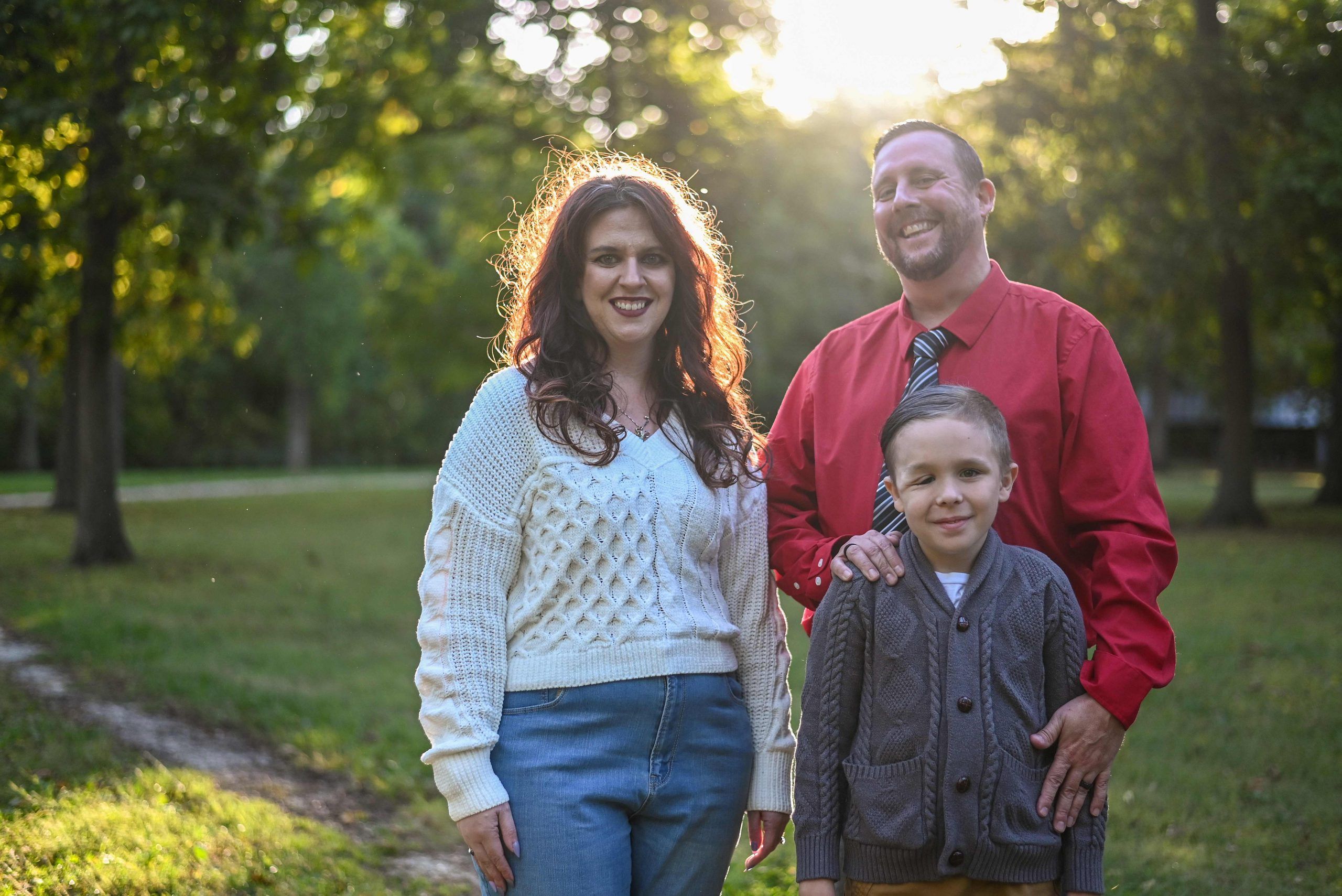

Sarah Peterson changes her one-year-old son’s diaper and notices a spot on his right ankle. She recognizes it because she has them, too. All over her body.
Sarah’s grandpa had them. Her dad and sisters have them. And she feared this day for Liam.
A rare condition
Sarah, 38, and Liam, 11, have neurofibromatosis type 1 (NF1), a genetic condition that causes tumors to form on nerve tissue. Typically noncancerous, the tumors can develop anywhere—internally or externally—including on the brain, spinal cord, and nerves. Beyond severe pain, NF1 can cause seizures, learning disabilities, loss of vision or hearing, digestive issues, cancer, and, in rare cases, death. It affects around 1 in 3,000 births.

Sarah and her husband, Brian, knew that having a baby came with a risk—each child of an affected parent has a 50% risk of inheriting NF1. Even so, Sarah tried to take 100% of the blame once they discovered little Liam had it, too. But Brian refused to let her take on that guilt.
“When I tried to blame myself,” she said, “he told me ‘It’s not your fault at all. I don’t blame you. Nobody should blame you, especially yourself.’”
Today, Liam is wise beyond his years. He has a cyst on his right eyelid, which he says makes him resemble the winking emoji. “It’s amazing,” said Sarah, “how he embraces and lives with it and just moves on and tells people, ‘It’s how I was born.’”
Sarah, though, took a little longer than Liam to feel the same way.
Invisible pain
Sarah didn’t grow up embracing life with the baseball-sized cyst on her right side—she spent her childhood and much of her adult life shielding it with her arm. It was so painful and sensitive, she couldn’t risk bumping into something or getting poked unexpectedly in the side.
She found other ways to mask it, too. “I was very self-conscious of wearing certain types of clothing—never anything form-fitting, everything was very loose and flowy,” Sarah said. “I would always try to find a way to hide it.”
Sarah also has smaller, less visible cysts all over her body. She believes she has them in her body, too, causing debilitating migraines and severe joint pain.
It wasn’t until her sister had surgery to remove a cyst from her neck that Sarah discovered the painful cyst on her side, and the others all over her body, was from her having NF1. She was 16.
Today, Sarah works as a front office specialist at Kettering Health Medical Group Orthopedics in Beavercreek. In May 2021, while in her previous role at a primary care practice in Miamisburg, a co-worker asked Sarah, “I’m not trying to be rude, but why haven’t you ever had surgery?”
Sarah responded with a long list of reasons, but later realized they weren’t good enough. She scheduled a consultation with Dr. Andrew Archer, a general surgeon for the Medical Group.
Confidence and Cupid
One month later, Dr. Archer removed the cyst from Sarah’s side and started a new chapter for her life.

“I could not be any happier with his work and what he has done for me,” she said. “After surgery, I felt like I could wear anything. That summer, I went out and bought my first two-piece swimsuit.”
Sarah had another surgery with Dr. Archer in November 2023 to remove a few concerning cysts from her breasts. Because women with NF1 live with an increased risk of breast cancer, Sarah had to start having mammograms younger and more often than most women. Realities like this that Sarah faces motivate her to raise awareness about NF1.
In February 2024, Sarah will participate in the Cupid Run in Cincinnati, an annual run/walk to raise money for NF research and resources. She has co-workers who plan to go show their support. Some may even participate with her.
You’re not alone
Rarely does Sarah find someone who has heard of NF1. In her more than four years with Kettering Health, she’s met just one patient who has it. Seeing their cysts from across the Orthopedics office lobby, Sarah approached them and said, “I may not have exactly what you’re having, but I know what you feel. I’ve walked in your shoes, and you’re not alone.”
Raising awareness for NF1 is one reason she shares her story. But most of all, she does it for Liam.
“My son has inspired me a lot,” said Sarah. “I feel like it’s more for him than it is for me. Because I want him to be able to get the resources I did not get at a young age.”
Liam sees a pediatric hematologist and oncologist at Dayton Children’s for routine testing. After about two years of taking medication, he’s seen the cyst on his eye slowly shrink.
Sarah urgers others to remember, “We may look a little different, and we may even be a little different, but we’re dealing with something that’s very painful and affects our bodies very differently than others.”
And to those living with NF1, she says to you, “You’re not alone.” If anything, you have Sarah and Liam.

