Safety message
The Kettering Health Patient Safety team has recently investigated several episodes of serious harm caused by medication errors. Investigation into these events has identified some concerning practices that contributed to the event:
- Verbal or over the phone orders given in violation of Kettering Health policies
- Providers giving incomplete medication orders
- Nursing not performing readback of verbal orders
- Nursing not requesting missing components of the verbal order
- Providers, Nursing, and Pharmacy bypassing Epic medication alerts
Please read the below case study highlighting an example of serious harm to a patient.
A 67-year-old patient was admitted for a planned laparoscopic incisional hernia repair. The patient received pain medication but requested a muscle relaxer. The nurse called the provider who initially ordered Robaxin. The nurse advised the provider that the patient had an allergy and that the patient requested Baclofen. The provider ordered Baclofen at the “same dose as before.” The nurse did not perform a readback and selected what they thought was the default dose in Epic. Two doses of Baclofen were given. The next day the patient was found lethargic and minimally responsive.
Please remember to follow the below guidelines
- In compliance with Kettering Health policy, verbal or over the phone orders should only be accepted “when it is impossible or impractical for the ordering practitioner to enter an electronic order.”
- When accepting a verbal order, if it is incomplete—for example, lacking a dose or frequency—request complete information. An incomplete order is invalid.
- “Continue the patient’s home dose” is not a valid order.
- It is a critical safety step and required by policy to do a verbal order readback from the RN to the ordering provider.
- It is dangerous to patients to bypass high-risk pop-up alerts for dangerous drug to drug interactions or dosage warnings. RNs cannot close a warning without discussing it with the ordering provider first.
Great Catches
- Thank you, Pam Norvell from Kettering Health Main Campus, for your Great Catch. Pam was an active participant in nurse/physician rounding and heard the patient was allergic to Zyvox. While preparing the patient for discharge, Zyvox came from the pharmacy. Pam remembered the patient was allergic to Zyvox and contacted the physician to get the medication changed. Pam returned the medication to the pharmacy and updated the patient’s record. Thank you for paying attention to detail and speaking up for safety.
- Thank you to the Soin Medical Center emergency center team, Ashley Blancet, Mitchell Carr, Courtney Stump, and Karen Harkins, for their Great Catch. This team discovered the emergency center periodic automatic replenishment (PAR) room was out of insulin syringes. The replacement syringes in the bin were tuberculosis syringes which are labeled in increments of 0.1. The nurse went to draw eight units of insulin and withdrew 0.8ml in the syringe. That would have equated to 80 units rather than the eight units that were ordered. The emergency center team performed double verification and caught the error prior to administering the medication to the patient. Thank you for paying attention to detail and speaking up for safety.
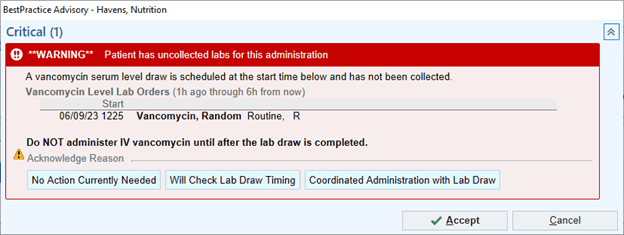
Medication safety: Vancomycin best practice advisory (BPA) update
Vancomycin is an antibiotic that requires monitoring of levels for safe and effective use. The timing of these levels is very important to allow for appropriate interpretation. A level that is drawn after a dose has been given will be unusable, causing a delay in assessing the patient’s status while additional labs are collected. This potentially puts patients at risk of having their infection insufficiently treated, or kidney injury due to high levels. To ensure levels are collected at the right time, a best practice advisory (BPA) will alert the nurse who is attempting to administer vancomycin. It will indicate if a level needs to be drawn around the time of the dose and has not yet been collected.