



Food is baked into every facet of our lives. We use food to find or extend comfort during life’s difficulties. We use food to connect with our culture or even find ourselves at home with the familiar and nostalgic. And with food, we even add to our sense of self: Who hasn’t been in heated debate about “Pepsi” vs. “Coke” or “Marion’s” vs. “LaRosa’s”? And with food we celebrate—much like we do during Hospital Week.
And the food we’re enjoying this week isn’t there by accident. Over the years, behind many of these celebrations are hundreds of Kettering Health team members using their craft, expertise, and heart for service.
“Our Nutrition Services and Culinary team prepare and serve a majority of the food provided for celebratory events held for KH employees,” said Chrissie Richards, executive director of Culinary and Nutrition Care. “While staff enjoy events, such as picnics, open houses, and more, our teams work hard to ensure you have the opportunity to enjoy delicious, top-quality food in a welcoming environment.”
And this isn’t the only place we see and encounter their expertise and care throughout Kettering Health.
Because with food, we do more than simply feed our bodies.
The power of food to heal
Among the more than 450-person Nutrition Services Department, the 30-plus Inpatient Nutrition Care team plays a deliberate role in our approach to whole-person care.
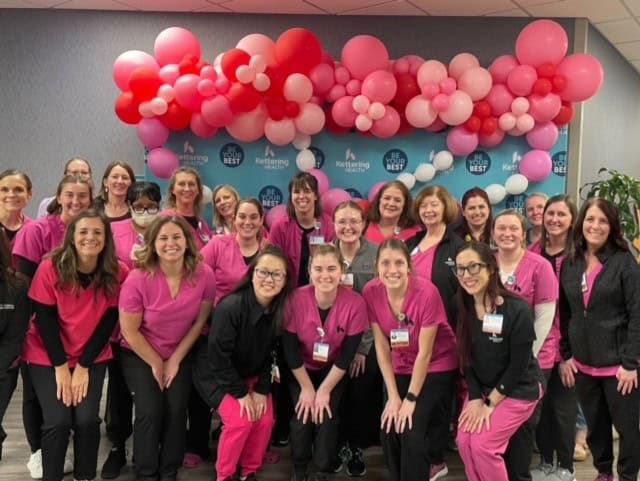
“We’re a small but mighty team focused on ensuring patients’ care is nutritionally sound during their stay,” said Laura Walters, MS, RD, LD, system director of Inpatient Clinical Nutrition.
Serving in medical centers throughout the system, this team of dietitians and dietitians coordinators keep patients’ nutrition dialed in to support their care and recovery. The impact their care and know-how have on patients and their health outcomes is, in a word, “significant,” says Chrissie Richards.
And this impact starts when a patient gets admitted—with a nutrition risk screening.
These screenings assess a patient’s risk for malnutrition, which can complicate a patient’s journey if not identified. “Malnutrition can cause pressure injuries, increased hospitalization, and other complications,” said Stephani Knisley, MS, RD, LD, system manager of Inpatient Clinical Nutrition. “The more nourished we can get them, the better their in-hospital care,” Stephani said, “and the less likely they are to need to come back.”
If a dietitian does diagnose a patient with malnutrition, it sets in motion a cascade of decisions to connect the patient to additional nutrition care.
To provide and monitor this care, dietitians are folded into a patient’s care team. “Doing so leads to one thing: timely patient care,” Laura said. This includes taking part in ICU and patient-floor rounding. This way, they can give and receive real-time information about a patient and make decisions quickly, such as when a patient may need a feeding tube.
In fact, at Kettering Health, the dietitians who serve longer than a year become credentialed to make nutrition-related decisions for patients quickly. “There’s no delay if a patient needs a diet change or if a tube feeding needs tweaked,” Stephani said.
Dietitians also help with menu planning for patients. They work with patients and the Culinary team regarding any dietary needs, whether it’s allergies, religious exemptions, or specific clinical restrictions. This collaborative care has led to moments of innovation in nutrition for patients, too. “Take our famous carrot cake,” Laura said. “If someone is a diabetic, on a heart-healthy diet, or a renal patient, they can’t eat that big slab of it. We worked with Culinary to create a smaller, cupcake-sized version of the carrot cake. Practically anyone can enjoy it now!”
To accomplish all this, dietitians earn a four-year degree in dietetics (nutrition) as well as a master’s degree, along with a nine-month to one-year long internship. They’re also registered with the American Academy of Nutrition and Commission on Dietetics along with earning their license to practice through the Ohio Medical Board.
The direct involvement of our Inpatient Nutrition Care teams makes all the difference in patients’ lives. In addition to the care and expertise they provide, another team ensures patients receive the food they order, carrot cake included.
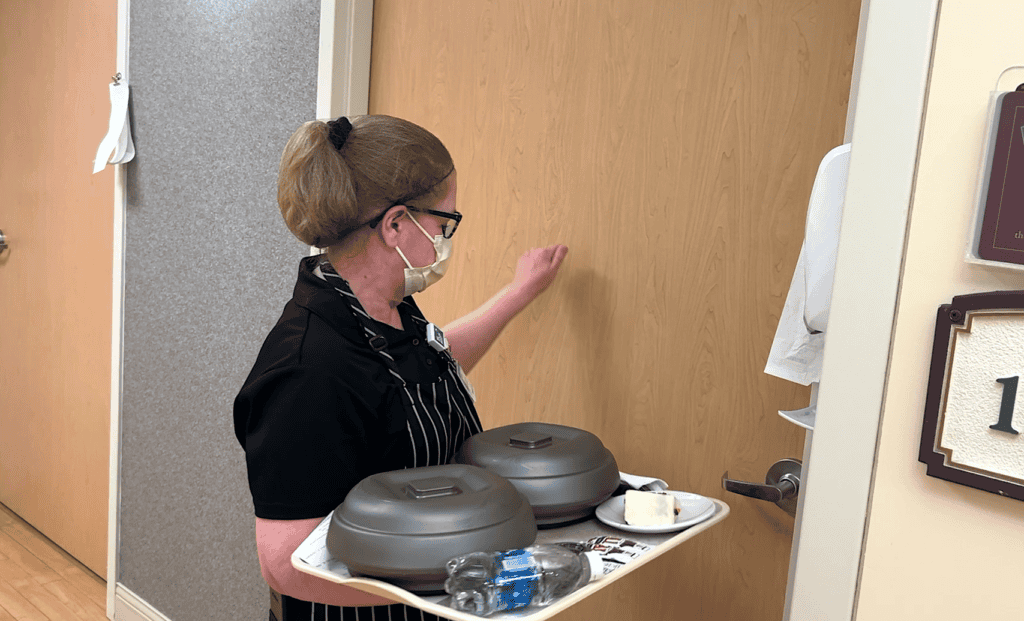
And for these team members, they do more than simply deliver a tray of food. They create an encounter with compassion.
The power of food to connect
Being a patient often means grappling with the loss of control. On top of not being in your home, the anxiety, uncertainty, and even fear can become overwhelming. But one important moment Kettering Health has ensured patients can feel dignified in is the chance to answer the question, “What do you want for dinner?”
Chrissie Richard explains: “Our patients don’t have much opportunity to make choices when they are in the hospital. Overall, they spend time listening to a lot of information and direction from their caregivers and physicians. Their meal selection is one area where we have given them the opportunity to make choices. Unlike many healthcare systems who provide non-select meals for their patients, Kettering Health offers full room service with an extensive menu offering many choices for our patients.”
And the team responsible for ensuring patients get those meals—our nutrition ambassadors—are delivering more than a patient’s food.
“When I think of our team’s role in patient care, two words come to mind,” said Carla Metzler MBA, RD, LD, interim director of nutrition services operations. “Connection and experience.”
This is because our nutrition ambassadors interact with our patients—a lot. It’s likely they’re second to nurses when it comes to the number of times they see a patient. And over the course of a patient’s stay, those interactions accumulate into stories of care and connection. And it’s the focus in why nutrition ambassadors are hired, trained, and encouraged to make the most of those moments they share with patients.
“When we hire new team members,” Carla said, “we’re quick to clarify that this is not a ‘typical’ food-service job. This role exists to support life-saving care. If we don’t show up ready to serve, ready to encourage, ready to be compassionate, it impacts the patient’s experience.”
And to do this well, they cultivate a deep sense of mission, learning how to advocate for patients via small moments of encouragement and active listening; seeing a few shared sentences as pivotal opportunities to dignify a patient, hear their voice, and help them feel seen. In this way, nutrition ambassadors become familiar, even familial, to patients.
“We’re kind of the mom of the medical center,” Carla said.
It’s in these moments of connection, however brief and benign, that the Nutrition Services team makes all the difference for patients, their families, and their friends. Along with the 153 nutrition ambassadors we have throughout the system, this team includes the 66 team members serving in our retail spaces, such as our cafes and coffee shops.
Carla points out that when a visitor arrives at a medical center’s coffee shop or café, they’re likely looking for more than a jolt of caffeine. They’re looking for a moment of self-care or even momentary escape to exhale—all without leaving the hospital.
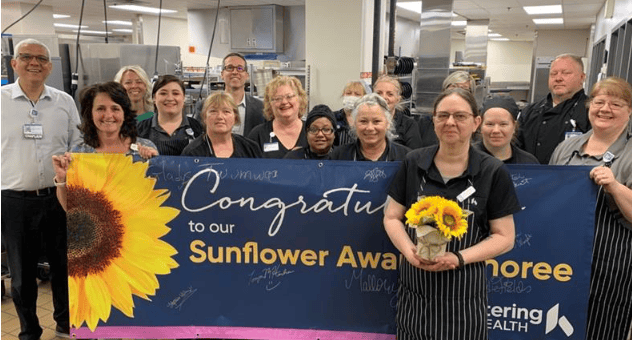
This is the “extra-mile” perspective she wants every nutrition ambassador and nutrition services team member to embody. To look beyond the obvious and read situations with a certain social literacy that helps them speak the language of connection and hope with patients and guests.
Granted, at the bottom, it’s about making sure patients receive the food they ordered. To ensure they have the consistency of a meal—of having one of the few things, if not the only thing, they could likely choose for themselves.
“We’re food-driven people,” Carla said. “We don’t think about food until it isn’t there. One of our roles is to make sure patients don’t have to worry about it not being there.”
After all, food does more than feed the body. As Carla pointed out, “Food feeds the soul.”